Smart insulin pens combined with continuous glucose monitoring (CGM) are transforming diabetes care by enabling automatic recording of insulin doses, improved glucose tracking, and personalized therapy decisions. This article explains what smart insulin pens are, how they integrate with CGM systems, the benefits for patients and clinicians, and the technical design challenges including non-volatile memory selection. Next-generation medical devices like smart insulin pens and CGMs are highly demanded to improve the accuracy of data acquisition, recording, and transmission.
What are Smart Insulin Pens?
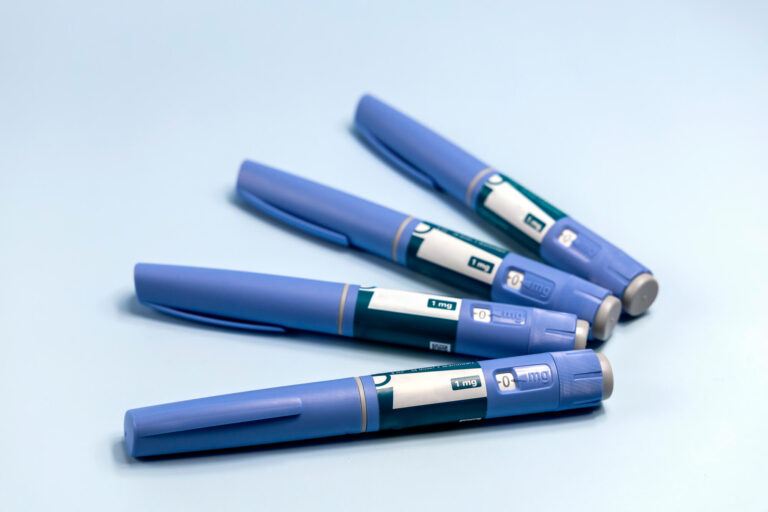
A smart insulin pen is an advanced medical device that automatically records the insulin dosage and injection time, and can link with a smartphone via low-power wireless technology. Users can check their administration history using a dedicated app, which helps prevent medication errors and improves self-management capabilities. Furthermore, sharing data with healthcare professionals allows for treatment optimization, contributing to the reduction of psychological burden and improvement of treatment continuation rates. Thus, the smart insulin pen is expected to be a crucial tool central to the digitalization of diabetes management.
In comparison to more traditional insulin pens, a smart insulin pen features are more advanced as shown in the table below.
| Feature | Smart Insulin Pen | Traditional Insulin Pen |
| Dose Recording | ✔︎ Real-time | ✘ Manual |
| Wireless Connectivity | ✔︎ Bluetooth | ✘ |
| CGM Integration | ✔︎ Yes | ✘ |
| Data Logging | ✔︎ App Sync | ✘ |
When using those devices, a combination of power-off detection and automated evacuation processing is required to protect data being recorded even during sudden power loss. For example, a mechanism is utilized where a capacitor is used to momentarily maintain power, and as soon as the MCU detects the power interruption, important logs are saved to the non-volatile memory. Designers must simulate the time required for save completion, capacitor capacity, and voltage drop speed in advance to ensure a safe design margin. Memory capable of high-speed writing, such as FeRAM, significantly contributes to simplifying this protection circuit.
How CGM Works with Smart Pens:
Continuous Glucose Monitoring
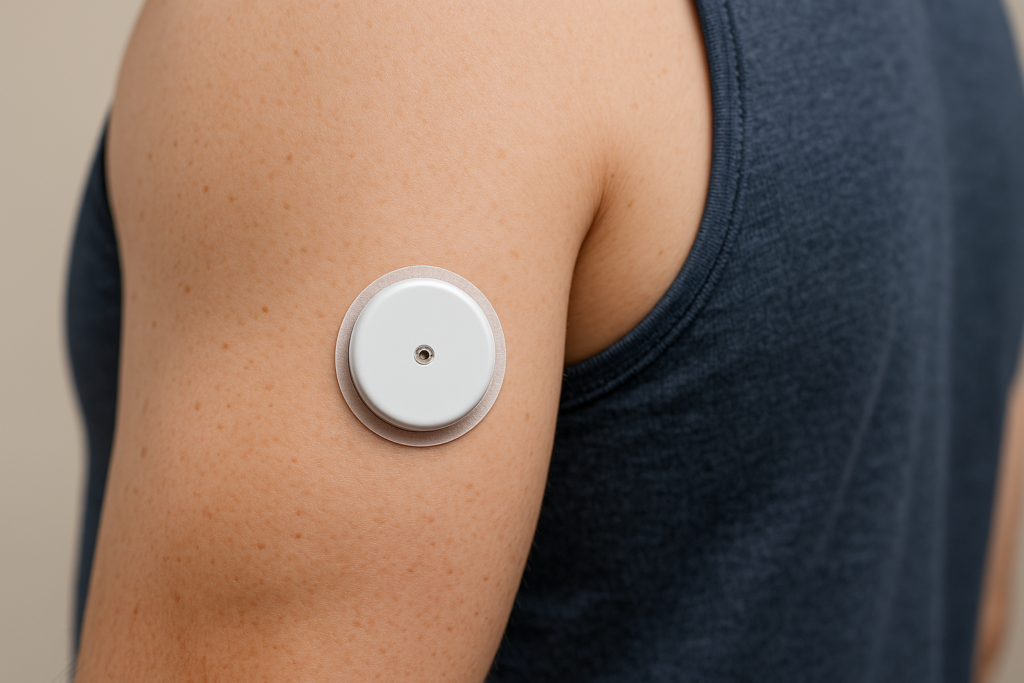
The linkage between CGM and smart insulin pens allows for the integrated management of real-time blood glucose data and insulin administration history. This enables optimal dosing decisions tailored to each patient’s blood glucose fluctuation patterns, drastically improving the quality of treatment.
Data Recording & Wireless Connectivity
Smart insulin pens require frequent recording and accurate long-term retention of critical data, such as insulin administration history and CGM reference values. Therefore, the introduction of non-volatile memory that can retain data even when power is cut off is essential. Circuit designers can ensure the longevity of the device and its safety as a medical device by adopting NVM technology that offers high endurance, low power consumption, and high reliability. Furthermore, preventing erroneous writing and optimizing the data structure are technical challenges closely linked to the reliability of the overall system.
Clinical & Patient Benefits of Smart Pens and CGM
Smart insulin pens require accurate and stable recording and storage of insulin administration history. Consequently, non-volatile memory is expected to meet multiple requirements: recording capacity, write endurance, low power consumption, and long-term reliability. achieving both miniaturization and long-term battery operation is a major design challenge. As the recorded data is also used for remote monitoring and clinical support by healthcare professionals, it is recognized as a tool that raises patients’ awareness of improving their own lifestyle habits and offers the advantage of streamlining daily record management.
Technical Challenges & Memory Design Considerations
Information recorded on smart insulin pens includes the insulin injection time and dosage, time elapsed since the last injection, and reference values of blood glucose from CGM. This data is expected to be utilized extensively for input into AI prediction models, implementation of personalized medicine, and remote monitoring by doctors. Adopting non-volatile memory that combines endurance and accessibility is essential for recording high-frequency and diverse information over the long term. Designers must ensure data integrity and chronological accuracy, focusing on a configuration that enables highly reliable information management.
Furthermore, the data structure for insulin administration logs requires a complex design that includes multi-layered elements beyond just recording administration time and dosage, such as CGM blood glucose data, device operating temperature, battery level, and system error information. This necessitates a format that anticipates data utilization during consultation and cloud linkage…
For those reasons, circuit design considerations must be the followings:
- Minimized power consumption for long-term battery operation
- Small but reliable components
- Medical standards compliance (environmental resistance, long lifespan, communication stability, malfunction prevention, etc)
- Data protection
Memory Types Comparison
Multiple types of NVM exist, including EEPROM, Flash, FRAM, nvSRAM, and ReRAM, each having distinct characteristics. Selecting the optimal technology by comparing write endurance, power consumption, recording capacity, cost, and implementation size according to the application determines the product’s performance and cost-efficiency. It is crucial for circuit designers to deeply understand the operating principles and limitations of each memory type and select the technology that best matches the dose recording and data logging characteristics of the smart insulin pen.
Advantages of FeRAM in comparison to EEPROM and Flash
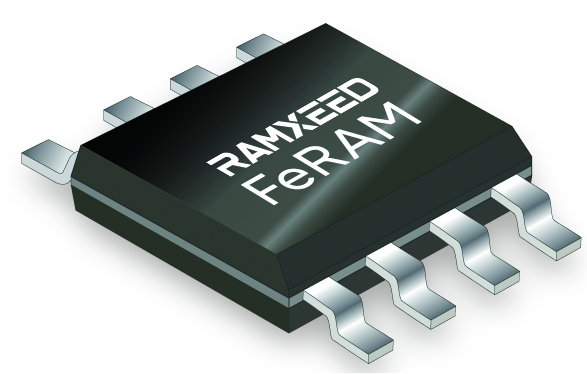
Continuous Glucose Monitoring (CGM) devices demand ultra-low power consumption and reliable data storage to operate seamlessly for weeks on small batteries. Ferroelectric RAM (FeRAM) is an ideal memory solution for these requirements. Unlike EEPROM or Flash, FeRAM offers non-volatility, extremely fast write speeds, and minimal power draw, enabling CGM sensors to log glucose data every minute without draining the battery. Its high endurance, up to 10¹⁵ rewrite cycles, ensures durability for frequent updates, while radiation resistance makes it safe for patients undergoing imaging procedures like MRI. By eliminating the need for charge pumps and reducing peak current, FeRAM supports compact battery designs and longer device lifespans, making it a cornerstone for next-generation medical IoT solutions such as smart insulin pens and CGMs.
Basic Performance of EEPROM and Flash Memory and Constraints in Medical Applications
| Memory | Maximum number of rewrites | Lifetime at one rewrite per second |
|---|---|---|
| FeRAM | 100 trillion | Approx. 3.17 million years |
| EEPROM | 4 million | Approx. 46 days |
| Flash | 100,000 | Approx. 28 hours |
EEPROM and Flash memory are NVM widely used in various industrial equipment, appealing due to their low cost and high versatility. However, the number of rewritable cycles is limited, typically ranging from tens of thousands to hundreds of thousands of times, posing an endurance challenge for applications requiring frequent data recording, such as smart insulin pens. Additionally, these memories require relatively long write times, necessitating the addition of external circuits to reliably retain data during power loss, which complicates circuit design. Therefore, their introduction into medical devices as storage for frequently updated log data requires careful consideration.
Achieving Both High Speed and High Reliability with FRAM and nvSRAM
FRAM (FeRAM, Ferroelectric RAM) and nvSRAM combine features such as high-speed writing performance, extremely high write endurance, and low power consumption, making them ideal choices for medical applications requiring frequent data logging, such as smart insulin pens. FRAM has a write endurance of over one trillion cycles, making it suitable for real-time log recording. nvSRAM incorporates a structure that can immediately retain data even when power is interrupted. A major advantage of these memories in medical devices, where miniaturization and safety are emphasized, is that they eliminate the need for additional backup circuits for power-loss data protection, simplifying design and enhancing reliability simultaneously. FeRAM allows continuous glucose monitoring integration in diabetes management technology.
Other Non-Volatile Memories
ReRAM and other new NVM technologies are attracting attention as candidates for implementation in next-generation smart medical devices due to characteristics like miniaturization, flexibility, and high density. These technologies allow for high integration through low-voltage operation and fine process compatibility, but challenges remain in terms of stable mass production and long-term operational reliability. Their introduction into medical applications requires careful observation of future technological maturity and standardization progress, considering operational stability, aging degradation, and compliance with medical device standards. Currently, FRAM and nvSRAM, which have proven track records and high reliability, are the primary adoption candidates.
Non-volatile memory requirements in medical devices
NVM incorporated into smart insulin pens must meet a wide range of requirements beyond low power consumption and size, including long-term reliability, security features, and environmental resistance. Examples include broad operating temperature compatibility, error correction through Error Correction Code (ECC), and data protection via encryption. Furthermore, adopting components that meet medical certification requirements and offer long-term supply availability ensures design continuity and stable commercial deployment. Component selection, considering the manufacturer’s supply system and the product’s life cycle, is also a critical decision point in medical device design.
On top of that, when selecting NVM, the performance of log data retention throughout the lifespan of the smart insulin pen is extremely critical. Most devices are expected to be used for two to three years, requiring that records be reliably retained even during battery changes or periods of non-use. Especially during medical consultations, it is often necessary to check administration history spanning several months to years, not just the recent records. To enhance product reliability and safety, it is essential to select memory that offers long data retention periods and resistance to degradation, even in high-temperature environments. This long-term retention performance is a fundamental requirement for guaranteeing the product safety of medical devices.
Actual circuit design requires a multi-layered and specific design approach to maximize NVM performance, including the interface with the Microcontroller Unit (MCU), power-loss data protection circuits, data log structure, and mechanisms to satisfy safety and security requirements. It is essential to have hardware and software coordination that guarantees data integrity across the entire system, not just selecting excellent memory.
Future Trends in Digital Diabetes Management

The linkage between smart insulin pens and CGMs is a foundational technology supporting the realization of next-generation healthcare, such as AI-driven dosing prediction, remote monitoring, and lifestyle improvement support. This device linkage enables real-time blood glucose fluctuation management and optimization of dosing timing, advancing personalized responses tailored to each patient while suppressing the risk of hypoglycemia. Going forward, the incorporation of even smaller, lower-power, and more secure NVM will be essential, increasing the importance of selecting memory capable of quickly and reliably processing and recording vast amounts of medical data. Thanks to those features, smart pens can be considered as one of the most advanced diabetes management technology.
NVM technology is a critical field expected to evolve even further in the future, as it strives to achieve the high endurance and low power consumption required by medical devices. FeRAM and nvSRAM, in particular, excel in write endurance and real-time capability, drawing attention from many circuit designers as practical options. Research is also advancing on next-generation memory using 2D materials and new structures, which are expected to enable even smaller and higher-density recording in the future. Future technology selection will require the ability to discern both proven track records and future potential.
Related Links
・FeRAM-embedded RFID Tags for Medical Applications – RAMXEED