What is EEPROM? Mechanism, Features, and Applications Explained [For Engineers]
This article provides a detailed explanation of the mechanism, characteristics, and applications of EEPROM (Electrically Erasable Programmable Read-Only Memory). It covers applications in microcontrollers and smart cards, differences from flash memory, and limitations on the number of write cycles, offering a comprehensive overview for engineers.
1. What is EEPROM? Basic Mechanism and Features
Definition and Overview
EEPROM (Electrically Erasable Programmable Read-Only Memory) is a type of non-volatile memory that allows data to be electrically written and erased. Since data is retained even when power is turned off, it is commonly used to store configuration settings and small amounts of data. Today, it is widely used in microcontrollers and embedded systems.
Differences from Other Non-Volatile Memories (Flash, EPROM, etc.)
Compared to other non-volatile memories such as flash memory and EPROM, EEPROM’s key feature is its ability to be rewritten at the byte level. Flash memory performs write/erase operations in blocks, making it suitable for large data storage, whereas EEPROM is better suited for applications requiring frequent updates of small data.
Advantages and Disadvantages of EEPROM
The advantages of EEPROM include the ability to rewrite data byte by byte and the ability to retain data even when the power is turned off. On the other hand, it has a limited number of rewrite cycles, generally around 1 million. Another disadvantage is that its write speed is slower compared to flash memory.
2. Structure and Operating Principles of EEPROM
What is Floating Gate Technology?
EEPROM operates using floating-gate MOSFET technology. The floating gate is an insulated region within the transistor’s gate structure that can store electrons, enabling data storage and retention.
Data Write and Erase Mechanism
In EEPROM, applying a voltage injects electrons into the floating gate, representing data as “1” or “0.” During erasure, an opposite voltage is applied to remove the electrons, returning the cell to its original state. This process enables rewriting.
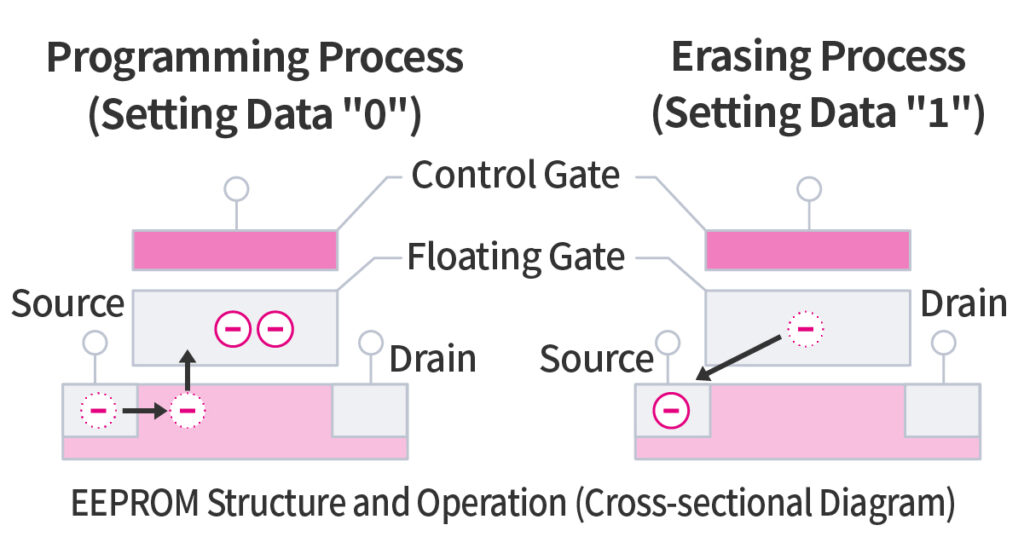
In EEPROM, applying a voltage injects electrons into the floating gate to record data. During erasure, an opposite voltage is applied to remove the electrons, returning the cell to its original state. This process enables rewriting.
Write Cycle Limits and Endurance
EEPROM has a limited number of write/erase cycles, typically around 1 million. For applications requiring frequent rewriting, alternative technologies such as FRAM (FeRAM) are recommended for better endurance.
3. Main Applications and Use Cases of EEPROM
Use of EEPROM in Microcontrollers
Many microcontrollers include built-in EEPROM to store configuration data and calibration values. For example, microcontrollers such as AVR and PIC use small-capacity EEPROM to retain essential data even after power loss.
Applications in Smart Cards and Automotive Systems
EEPROM is also used in smart cards and automotive ECUs (engine control units). In smart cards, it is used to store user authentication information, and in ECUs, it is used to store engine and transmission control data.
Role in Industrial Equipment and IoT Devices
In industrial equipment and IoT devices, EEPROM is used to store operation logs and sensor data. It is particularly suitable for applications requiring frequent updates of small data and is often used in combination with real-time clocks and various sensors.
4. Conclusion
Importance and Future Outlook
EEPROM is a non-volatile memory well-suited for storing small amounts of data with frequent updates. Although its role has diminished somewhat due to advances in flash memory, it remains important in specific applications.
Selection Criteria Compared to Other Non-Volatile Memories
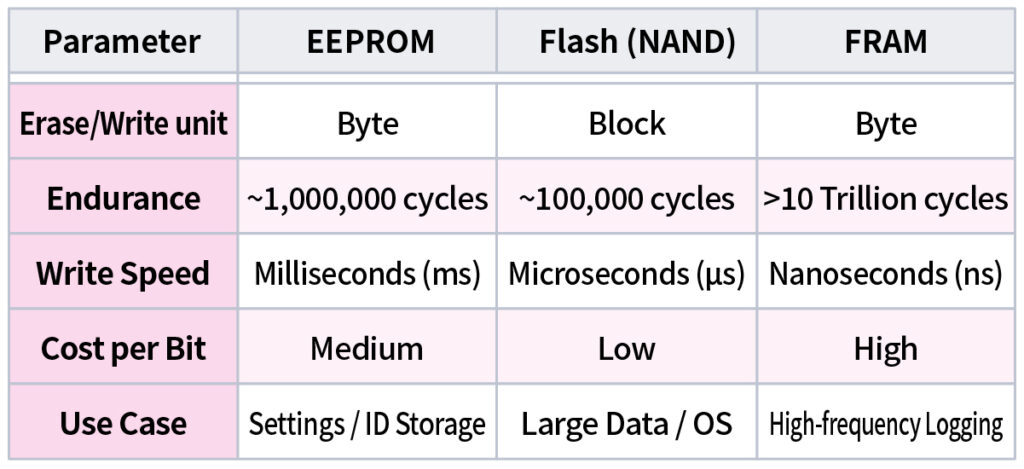
Compared to other non-volatile memory such as flash memory and FRAM, EEPROM requires careful selection based on the application. EEPROM is suitable for byte-level rewriting, flash memory for storing large amounts of data, and FRAM is advantageous when a high number of rewrite cycles are required.
Key Considerations for Engineers
When utilizing EEPROM, it is necessary to consider the maximum number of write cycles and the reliability of data retention. Furthermore, wear leveling technology can be introduced as needed to extend the write lifespan.
EEPROM remains an important technology that will continue to be used in specific applications, and understanding its appropriate use is crucial for engineers.