FRAM and Embedded Non-Volatile Memory: Fundamentals and Applications — Exploring Hybrid Configurations with SRAM and Flash
This article explains the basic principles of FRAM, compares it with other non-volatile memories, and reviews the design advantages of embedded configurations as well as key considerations during implementation. It provides practical insights for addressing design challenges that require high-speed rewriting and low power consumption.
What Is FRAM? — A New Option for Non-Volatile Memory
FRAM (FeRAM, Ferroelectric RAM) is a type of non-volatile memory that uses ferroelectric materials to retain data even when power is turned off. It combines high-speed read/write performance, high write endurance, and low power consumption, making it suitable for applications that are difficult to address with conventional EEPROM or flash memory.
This section details the basic structure and characteristics of FRAM, clarifies its differences and advantages compared to other non-volatile memories, and examines its practicality and design potential based on recent application examples.
Basic Structure and Operating Principle of FRAM
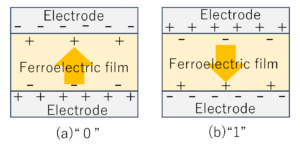
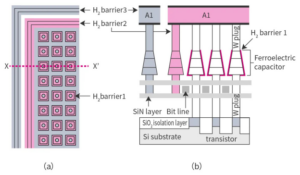
FeRAM can record data thanks to a ferroelectric capacitor in its cell structure and stores information through polarization reversal. This structure enables non-volatility—retaining data even when power is turned off—while also achieving read/write speeds comparable to DRAM and SRAM. A typical FRAM cell has a 1T-1C (one transistor, one capacitor) structure, where data (“1” or “0”) is written by changing the polarization state of the ferroelectric material. Write operations are completed in a single cycle, and read operations can be performed non-destructively, enabling fast, low-power, and stable operation.
Comparison with Other Non-Volatile Memories (Flash, EEPROM, MRAM, etc.)
Compared to EEPROM and NOR flash, FRAM offers faster write speed and significantly lower power consumption. In terms of endurance, FRAM supports more than 10 trillion write cycles, which is orders of magnitude higher than EEPROM (around 1 million cycles) and flash (around 100 thousand cycles).
In addition, its low write voltage makes it suitable for battery-powered devices and low-voltage circuits, and it performs well in systems that require real-time operation or frequent data updates. Compared to MRAM, FRAM has advantages in power consumption and simpler device structure.
Use Cases of FRAM in Various Applications
FRAM is particularly optimal for environments where power loss may occur or frequent data rewriting is required. Examples include storing operation logs in industrial equipment, real-time control parameters, patient data in medical devices, log storage in smart meters, and event data recorders in automotive applications. It is also widely used in compact devices such as RFID tags and wearable devices, where low power consumption and high endurance are essential. In recent years, microcontrollers with embedded FRAM have also emerged, enabling more flexible application design.
Advantages and Design Considerations of Hybrid Memory Configurations
By combining FRAM with other types of memory in a single system, it is possible to leverage the strengths of each memory type to achieve optimal performance and reliability. Configurations such as FRAM + SRAM or FRAM + flash enable flexible design tailored to requirements for speed, power, and data retention. However, hybrid designs also present challenges, including circuit interference, process compatibility, and increased control complexity. The next paragraph explains the implementation benefits and design considerations of hybrid configurations with practical examples.
Benefits of FRAM + SRAM and FRAM + Flash Configurations
Using FeRAM together with SRAM or flash allows the construction of a flexible memory map that balances read/write speed and data persistence. For example, SRAM can be used for high-speed working memory, while FRAM can store data that requires persistence, achieving a balance between performance and reliability. Combining it with flash also allows separation of large-capacity storage from low-power, frequently accessed regions, enabling optimized power efficiency. Such hybrid configurations have been widely adopted in fields such as IoT, medical, and automotive applications.
Process, Signal Interference, and Power Management Considerations
In hybrid memory configurations, different memory elements operate on the same substrate, making it important to minimize signal interference and noise effects. In fact, careful timing design and layout considerations are required when combining high-speed SRAM with FRAM, which uses pulse voltage during write operations. Since FRAM operates at lower voltage, power design must ensure compatibility with other memory types. In addition, to maintain data integrity during power on/off events, proper implementation of memory control logic and write protection mechanisms is essential.
Effectiveness of Hybrid Configurations Based on Implementation Examples
Recently, many products adopting hybrid configurations of FRAM and other memories have been introduced, and valuable insights have been gained from these cases. For example, integrating FeRAM and SRAM in low-power microcontrollers can lead to the achievement of both high-speed data processing and data protection during power loss. In medical devices, continuous measurement data can be stored in FRAM and transferred to flash during communication, minimizing communication power while maintaining high reliability. These examples demonstrate the effectiveness of hybrid memory design tailored to specific applications.
Technical Perspectives for Memory Selection
When selecting non-volatile memory, it is necessary to evaluate multiple technical factors, such as speed, write endurance, power consumption, and data retention, in a balanced manner based on application requirements. When considering hybrid configurations including FRAM, it is also important to take a system-level perspective, including overall behavior and the impact on control logic. This section provides a detailed explanation of key technical considerations for memory selection.
Key Comparison Points: Write Speed, Endurance, and Power Consumption
FRAM supports high-speed writing of less than 1 microsecond and offers excellent write performance compared to other non-volatile memories. EEPROM and flash involve write delays on the order of milliseconds and have strict limits on write cycles, which can affect reliability in applications with frequent updates. FRAM supports over 10 trillion write cycles and retains data even after power is removed, enabling both real-time operation and high reliability. In addition, its low-voltage and low-power operation make it suitable for mobile and battery-powered devices.
Data Retention Requirements and Backup-Free Design
In conventional SRAM, continuous power supply is required to retain data, and external backup mechanisms such as batteries or supercapacitors are needed during power loss. FRAM eliminates the need for such external retention mechanisms, as it can retain data immediately even after power loss, improving system reliability and simplifying design. Unlike flash memory, it does not have strict limits on rewrite cycles, making it suitable for long-term use in applications such as active data logging. Backup-free design also offers significant advantages in maintenance, cost, and space efficiency.
Considerations for Implementation in Mixed LSI and SoC
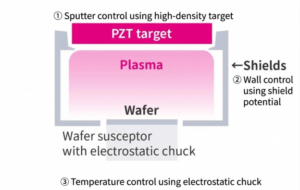
When embedding FRAM in SoCs or ASICs, process compatibility and layout design are critical. FRAM cells require a dedicated ferroelectric process, which may introduce additional steps when combined with standard CMOS. In addition, system integration requires careful handling of control logic complexity, signal timing coordination with other IP blocks, and EMC (electromagnetic interference) considerations. Proper clock synchronization, data bus design, and memory protection mechanisms help ensure overall system stability and scalability.
Applicability and Future Outlook of FRAM-Based Hybrid Configurations
Designs that combine FRAM with other memory types are gaining attention as a way to meet requirements that are difficult to achieve with conventional architectures. FRAM is especially well suited for applications requiring real-time data logging, frequent rewriting, low power consumption, and reliable operation during power loss. The following explanation outlines typical use cases where hybrid configurations are effective, along with future technological trends and key considerations during design evaluation. As FRAM technology continues to advance, the range of applications for hybrid configurations is expected to expand further.
Cases Where FRAM Adoption Is Effective
Typical use cases where FRAM is effective include log storage in environments with high risk of power loss, retention of real-time control parameters, IoT devices and sensor nodes with frequent configuration updates, and medical, industrial, and automotive systems requiring long lifetime and high reliability. For example, in smart meters, data protection during power loss is essential, and FRAM enables battery-less configurations. It is also well suited for low-power, compact devices such as RFID and wearable devices, providing high-performance non-volatile memory in space-constrained environments.
Design Flow and Validation Points for Evaluation and Implementation
When introducing FRAM, it is important to first define application requirements—such as write frequency, data retention time, operating voltage, and power consumption—and then determine the appropriate memory configuration. During evaluation, simulations should include FRAM-specific operating conditions (such as write timing and data retention behavior), and data integrity during power loss must be verified. In hybrid configurations, verification of memory contention, signal interference, and latency control is also necessary. Through prototyping and performance evaluation, optimizing the configuration to meet system requirements is key to successful implementation.
FeRAM-embedded ASIC/ASSP
https://www.ramxeed.com/products/asic-assp/