Eliminating Product Lifespan Constraints: A Design Approach That Discards Battery Life Calculations
A product’s lifespan is often determined by its battery life. However, calculating battery life is far from simple.
The reason is that backup batteries are only used while the backup circuit is active—that is, while the product is powered off. The duration varies significantly depending on user habits and the installation environment.
To estimate the product’s lifespan, one must make assumptions about the time the product spends not in use. This contradiction is what makes lifespan calculations difficult for designers.
This calls for a new design philosophy that removes these constraints on product lifespan calculations.
Theoretical Product Lifespan Determined by Backup Current and Battery Capacity
The product lifespan of embedded devices can often be calculated based on backup current and backup battery capacity. Typical examples include industrial meters, POS terminals, and controllers for factory automation (FA) equipment.
These products require the continuous retention of settings and operational status data. Consequently, volatile memory—such as SRAM—has been widely used.
When power is not supplied, SRAM loses its stored data. To retain data during power outages or when the main power is off, a backup battery such as a lithium battery is used to supply continuous current to the SRAM.
This design approach has long been the standard practice, and product lifespan can be defined as the time during which data is retained (data retention time).
Theoretically, the lifespan should be determined by the following simple formula:
Data retention time (h) = Battery capacity (Ah) / Backup current (A)
For instance, with a battery capacity of 200 mAh and a backup current of 5 μA, the calculated retention time is 40,000 hours—or more than four years.
The Burden on Designers to Calculate Lifespan While Accounting for Environmental Changes
However, the actual data retention time does not always align with this formula.
The backup battery operates while the product’s main power is turned off—in other words, during periods when the product is not in use.
The duration of this period varies significantly depending on the installation environment and user habits. Designers must therefore estimate this unknown timeframe.
Furthermore, factors such as ambient temperature and battery self-discharge come into play.
Increase in Backup Current Due to Temperature Changes
Backup current fluctuates significantly depending on temperature conditions.
SRAM leakage current increases exponentially as the temperature rises. It is not uncommon for current consumption—which might be just a few microamperes (μA) at room temperature—to jump by more than an order of magnitude in high-temperature environments.
While the backup current may be 5 μA at room temperature (25°C), it can rise to 15 μA at 45°C and even 50 μA at 65°C.
Variations Due to Battery Self-Discharge
Backup batteries are subject to self-discharge.
Battery capacity gradually declines based on storage duration and ambient temperature; generally, the capacity decreases by about 1% per year.
Batteries also vary by manufacturing lot and manufacturer, leading to variability in self-discharge rates.
Considering Product Lifespan
Engineers responsible for setting the product warranty period must base their calculations on “worst-case” values that account for all these factors.
The previously mentioned theoretical lifespan of four years applies only to a backup battery in a device that is not being used at all; it is not workable to use this figure as the actual product lifespan.
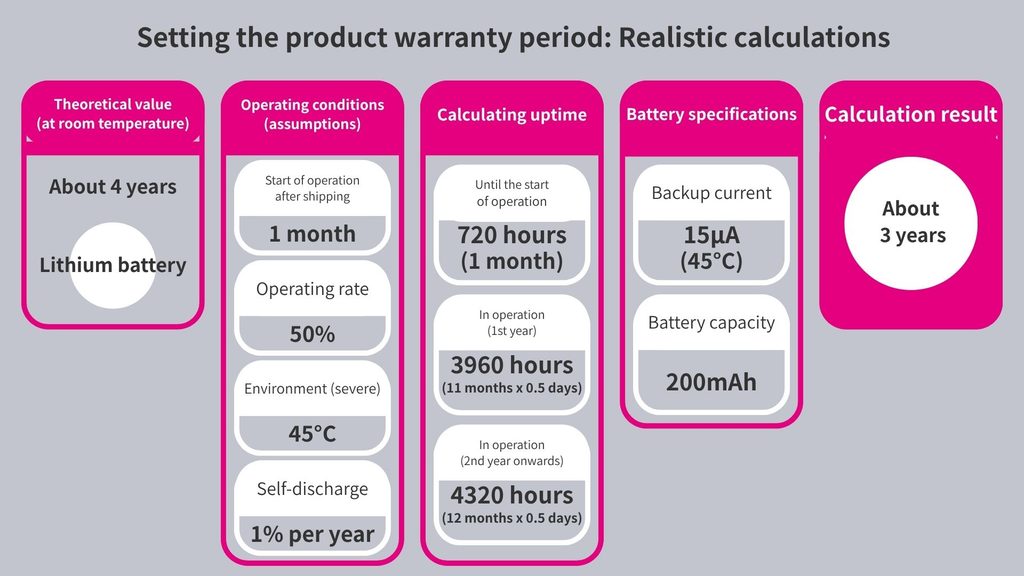
The battery lifespan is then calculated by assuming specific operating conditions for the device.
[Backup Circuit Operating Time]
- Time from shipment to the start of operation: 1 month.
- Operating rate: 50% (assuming the device is inactive during nights, long holidays, etc.).
- Operating environment: 45°C (to account for harsh conditions).
- Self-discharge rate: 1% per year.
Based on these parameters, the backup circuit’s operating time is calculated as follows:
- Time until operation starts: 720 hours (24 hours × 30 days)
- During operation (Year 1): 3,960 hours (24 hours × 30 days × 11 months × 0.5)
- During operation (Year 2 onwards): 4,320 hours (24 hours × 30 days × 12 months × 0.5)
- Backup current: 15 μA (at 45°C)
Assuming a battery capacity of 200 mAh, the resulting lifespan for the lithium battery is approximately three years.
While this is just one example, it demonstrates that—especially when environmental conditions are factored in—a long product lifespan cannot be expected. Increasing the battery capacity would be necessary to extend the lifespan.
Note that this is merely an example; assumptions regarding factors such as temperature conditions must be adjusted according to the specific product.
A Design Approach Free from Battery Life Calculations
To escape this burden, one can shift perspectives. Conventional solutions have relied on improving the performance of batteries and circuits.
But what if the backup batteries were eliminated altogether?
A Concept That Makes Backup Batteries Unnecessary
Backup batteries are required because SRAM loses data when the power is turned off.
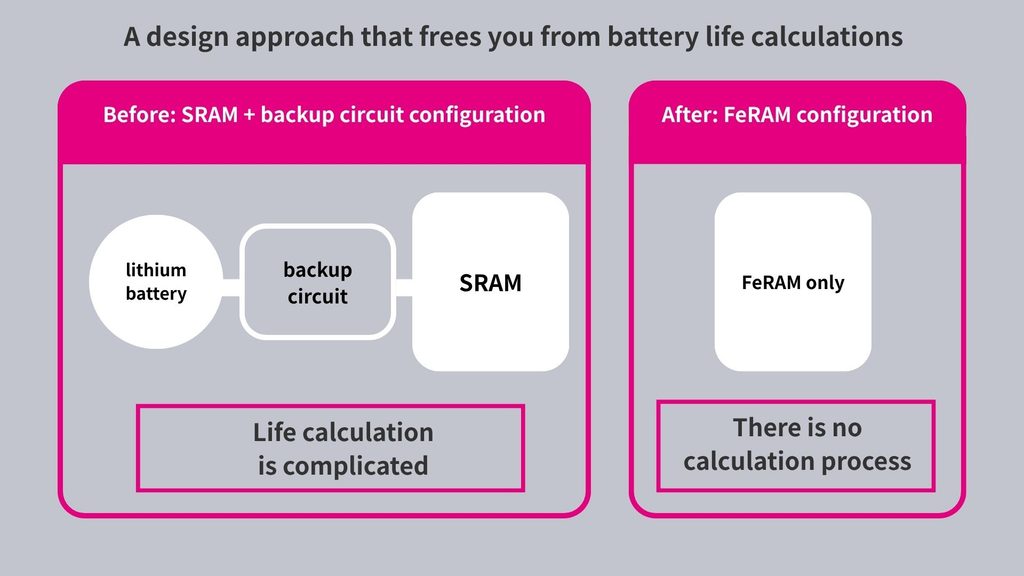
Conversely, if memory that retains data even without power is used, the backup battery itself becomes unnecessary. Replacing existing memory with non-volatile memory is an option based on this concept.
Eliminating Lifespan Constraints with FeRAM
Specifically, FeRAM (FRAM, Ferroelectric RAM)—a type of non-volatile memory—is adopted instead of SRAM.
By using FeRAM, which retains data even when powered down, backup power circuitry is no longer needed. Consequently, the task of calculating battery lifespan can be completely eliminated from the design process.
This replacement will deliver significant benefits for industrial equipment and automotive electronics, where power-off periods are difficult to predict and long-term, maintenance-free operation is required.
FeRAM also offers high resistance to noise and power fluctuations, making it an ideal choice for fields where data reliability is directly linked to product value.
Enhancing Product Reliability and Warranty Certainty by Eliminating Batteries
The fundamental benefit of eliminating batteries is not about cost savings.
The greatest value lies in eliminating uncertain processes from the design workflow—those involving variability in battery capacity and environmental conditions. It also eliminates the headache of determining warranty periods.
It removes the issues of maintenance and environmental concerns associated with battery depletion in the field, as well as the need for battery replacement and recycling.
The key point here is not simply making calculations easier; the goal is to eliminate the need for such calculations entirely.
This frees the design process from the constraints of calculating battery life—a factor that previously limited product longevity and represents a shift in design philosophy that qualitatively improves product reliability.
RAMXEED FeRAM Product Lineup