What Is PIM (Processing-in-Memory)? Fundamentals and Applications of Next-Generation Memory-Centric Computing
PIM (Processing-in-Memory, or IMC: In-Memory Computing) is a next-generation technology that integrates computing functions directly into memory, eliminating the bottlenecks of conventional architectures. This article explores how PIM works and its advantages, as well as its potential integration with FeRAM and ReRAM, and the initiatives of leading companies in the field, which are drawing increasing interest in AI and big data applications.
What Is PIM (Processing-in-Memory)?
Definition of PIM and the Challenges Behind It
PIM (Processing-in-Memory) is a technology that significantly improves efficiency by embedding computation directly into memory, thereby minimizing data transfer between processors and memory. In conventional architectures, data must be moved frequently between the CPU and DRAM, creating a major bottleneck. This limitation is particularly significant in applications such as AI and big data analytics, where large volumes of data are processed and memory bandwidth becomes a constraint on performance. PIM has attracted attention as a new approach to addressing this challenge.
Differences from Conventional Architectures
In conventional computer architectures, CPUs and GPUs perform computations while memory is responsible for storing and retrieving data. Although this architecture offers simplicity and flexibility, it requires frequent movement of large amounts of data, resulting in increased power consumption and latency. PIM fundamentally redefines this structure by integrating computational functions directly into memory, enabling processing to occur within the memory itself which results in the achievement of high processing performance and minimized data movement.
PIM Classifications and Architecture Examples
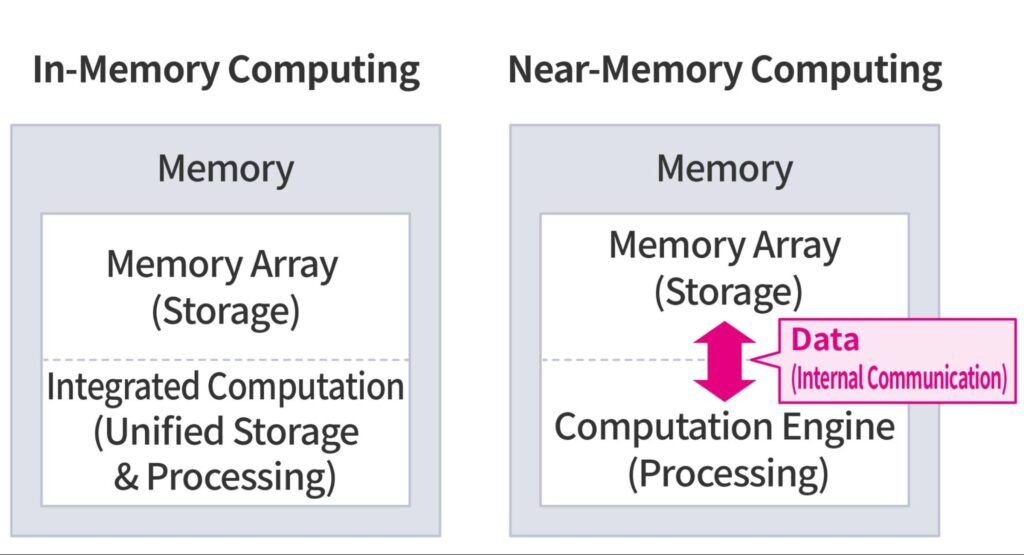
PIM can generally be divided into two categories: “In-Memory Computing(IMC)” and “Near-Memory Computing (NMC).” In the former, memory cells and computational circuits are physically integrated, providing high processing efficiency but increasing design complexity. In the latter, computational circuits are placed near the memory, allowing the benefits of PIM to be realized while maintaining compatibility with conventional manufacturing processes. Notable examples include include Samsung’s HBM-PIM and UPMEM’s RISC-V-based processing units embedded within DRAM.
Technical Features and Advantages of PIM
Performance Improvements Through Reduced Data Transfer
The greatest advantage of PIM is improved processing performance through the reduction of data transfers. In conventional architectures, bus bandwidth between the CPU and memory limits performance, especially during large-scale data processing. With PIM, computations are performed close to the data, reducing bus congestion and lowering computation of information latency. This makes PIM particularly effective for data-intensive applications such as AI inference, image processing, and scientific computing.
Power Optimization and Energy-Saving Benefits
Frequent data transfers between memory and CPUs consume consume substantial energy. By performing computations within or near memory, PIM can substantially reduce this energy cost. Samsung has reported that its HBM-PIM technology can achieve up to a 70% reduction in power consumption compared with conventional processing methods. Energy efficiency is particularly important for battery-powered edge devices and data centers, making PIM well suited to these applications.
Scalability and Real-Time Processing Capability
PIM architectures enable computational units to be distributed across large numbers of memory cells, providing excellent scalability. This improves the ability to process large datasets in parallel and in real time. In addition, because data remains physically within memory, cache misses occur less frequently, making processing times more predictable. These characteristics also make PIM suitable for robotics and industrial IoT applications that require real-time performance.
PIM Application Areas and Related Memory Technologies
Use Cases in AI and Machine Learning
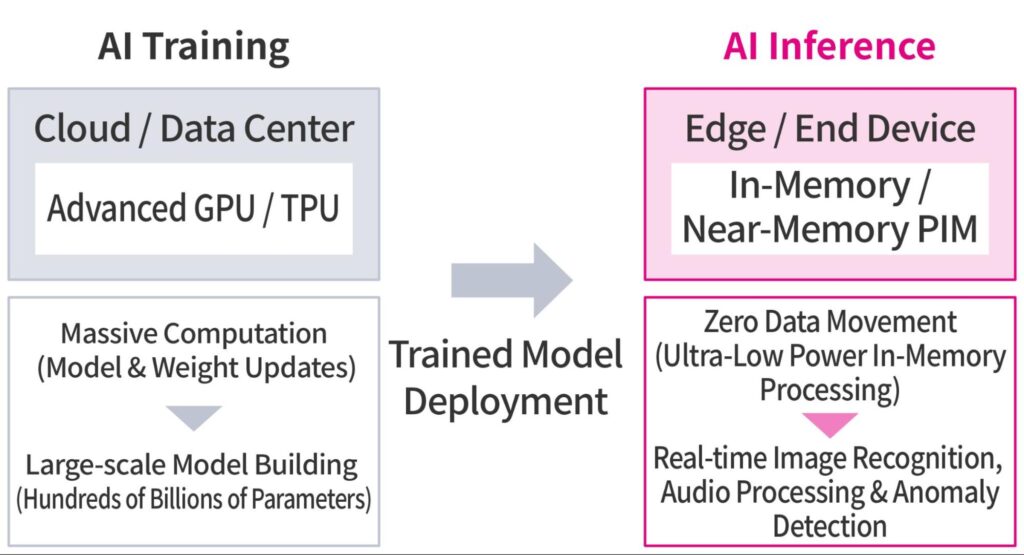
PIM is being increasingly adopted in AI and machine learning applications. These workloads repeatedly perform computations on large volumes of parameters and weight data stored in memory, making data transfer costs a significant challenge. By utilizing PIM, various inference processes and learning algorithms can be executed more quickly and with lower power consumption. Companies such as Google, NVIDIA, and Samsung are actively researching and developing AI accelerators that leverage PIM technology, and its use is expected to expand further in the future.
Compatibility and Potential of FeRAM and ReRAM
FeRAM (Ferroelectric RAM) and ReRAM (Resistive RAM) are memory technologies characterized by non-volatility, high integration density, and low power consumption, making them highly compatible with PIM architectures. By using FeRAM or ReRAM as storage media within PIM systems, data can be retained even when power is removed while still enabling direct processing, making these technologies well suited for energy-efficient edge AI and IoT applications. In particular, ReRAM-based PIM can be highly effective for lightweight processing tasks such as sensor data preprocessing and data filtering.
Initiatives by Major Companies and Research Institutions
To commercialize PIM technology, major players in the semiconductor industry and university research institutions are actively engaged in development efforts. Samsung has moved into mass production with its HBM-PIM technology, while UPMEM offers DRAM-based PIM chips incorporating RISC-V processors. Renesas Electronics is also conducting research and development on PIM chips for edge AI applications, and deployment is accelerating both in Japan and abroad. Along with future standardization and infrastructure development, the broader adoption of this technology is expected to accelerate.
Conclusion
The Essence of PIM and Future Outlook
PIM is an innovative architecture that fundamentally addresses traditional computing bottlenecks by integrating memory and computation. In data-centric fields such as AI, big data, and IoT, PIM enables both high performance and efficiency by focusing on data utilization rather than data movement. Going forward, important challenges will include the development of software toolchains and the establishment of strategies for integration with existing processors.
Key Points for Design Engineers
Implementing PIM requires consideration from multiple perspectives, including overall system architecture, computational methods optimized for memory characteristics, and software control. For design engineers, it is especially important to understand how PIM differs from traditional separated architectures and to make informed decisions regarding memory selection and accelerator configurations. Furthermore, combining PIM with non-volatile memory technologies such as FeRAM and ReRAM may enable highly efficient, low-power system designs and become an important differentiating factor in future products.
Comparison with Related Technologies and Selection Guidelines
Technologies that compete with or complement PIM include NVM computing, Near-Memory Computing, and SoC-based AI accelerators. Each technology has its own strengths and is best suited to particular applications. For example, PIM offers advantages when real-time processing is a priority, while large-scale training workloads may benefit from combining GPUs or TPUs with PIM. Design engineers must evaluate application requirements and carefully balance performance, power consumption, and cost when selecting technologies.
RAMXEED FeRAM Product Lineup
RAMXEED ReRAM Product Lineup