[In-Depth Guide] How Edge AI Is Evolving and the Essential Role of Non-Volatile Memory
This guide provides a comprehensive explanation of how Edge AI functions and the critical role non-volatile memory plays in enhancing performance. It covers the key concepts design engineers need—from real-time inference, power efficiency, and thermal design considerations to comparisons of next-generation technologies (such as MRAM, ReRAM, and FeRAM/FRAM), implementation examples, and the latest architectures like CiM (Compute-in-Memory).
What Is Edge AI? Fundamentals of Its Mechanism and Architecture
Edge AI is a technology that processes data directly on the device itself, without relying on the cloud. As the Internet of Things (IoT) becomes more widespread and demand for real-time performance and energy efficiency grows, implementing efficient AI processing through the efficient interaction between processors and memory has become a critical focus in system design.
Edge AI vs. Cloud AI: Why Run AI at the Edge?
Conventional cloud AI systems collect and analyze vast amounts of data in the cloud before returning results to the device. In contrast, Edge AI analyzes data from sensors and other sources in real time, locally; this minimizes communication latency, making it ideal for applications that demand immediate responsiveness. Autonomous driving, industrial robotics, and surveillance cameras, for example, require millisecond-level response times. Reducing reliance on the cloud also offers advantages in terms of security and privacy protection. For these reasons, Edge AI is expected to become an increasingly mainstream architecture.
Basic Edge AI Architecture: Collaboration Between Processors, Memory, and Sensors
A typical Edge AI configuration consists of sensors to capture input data, a processor to perform inference, and memory for data buffering and temporary storage. The workflow involves the processor analyzing sensor-collected information in real time using AI algorithms, then either temporarily storing the results in memory or transmitting them to other devices. In this setup, data transfer efficiency between components directly impacts overall performance, making bus bandwidth and latency reduction key design priorities. In particular, the memory configuration—specifically its ability to supply data to the processing unit without bottlenecks—significantly determines system availability and throughput.
The Role of Memory in Real-Time Inference and Power Optimization
Achieving real-time inference requires more than just fast computation; it demands strong “data supply capability”—the ability to read out large parameter sets without delay. In conventional architectures, data transfer from storage to main memory often creates a bottleneck, leading to delays before inference begins. Adopting high-speed memory technology allows model weights and lookup tables to be instantly loaded into the processor, thereby minimizing overall system latency. Since edge AI applications often involve significant idle time, balancing high-speed processing during active operation with the suppression of leakage current during standby is key to optimizing total power consumption.
Memory Requirements for Edge AI: Performance, Power Efficiency, and Write Endurance
Memory is a critical factor determining the performance and longevity of edge AI systems. These systems must handle frequent data access within strict power and thermal constraints, so speed, current, and write endurance all warrant evaluation from multiple angles. Selecting the right technology—balanced according to the operational cycle—directly contributes to enhanced product reliability.
Memory Performance Requirements for Edge AI Processing
In Edge AI, memory bandwidth (throughput) is the key to performance, as the goal is to maximize inferences per second (IPS). Even with a high-speed processor, the performance cannot be fully utilized if memory cannot supply data quickly enough, leaving the computing units idle. Random access performance—acting as a cache to hold intermediate data during inference—is also crucial. Without sufficient responsiveness for frequent address jumps, the system becomes a source of processing latency. Designs must account for effective access speed, not just peak transfer rates.
Volatile vs. Non-Volatile Memory: Benefits and Limitations
Volatile memory (such as SRAM and DRAM) offers extremely fast, nanosecond-level access, making it ideal for computational work areas. However, standby leakage power and circuit area can be drawbacks. Conversely, non-volatile memory (such as MRAM, ReRAM, and FeRAM) allows for high integration density and compact physical size, yet certain types face physical constraints regarding write speeds and endurance (write cycles). The standard design approach is therefore a hybrid configuration that assigns memory types based on specific needs: using volatile memory for frequently updated areas and non-volatile memory for storing code and constants.
Frequent Rewriting and Power Consumption: Design Challenges and the Role of Non-Volatile Memory
AI inference involves intensive write operations within short timeframes, such as updating intermediate layer data in neural networks. Since the energy consumed during write operations (active power) is dissipated as heat, memory energy efficiency is critical for thermal management. While conventional Flash memory entails significant overhead due to the need for page-level erasure, next-generation non-volatile memory supports byte-level rewriting, thereby reducing unnecessary power consumption. For applications involving frequent data updates, selecting devices that minimize write energy is key to achieving fanless designs and compact form factors.
Convergence of Evolving Non-Volatile Memory Technology and Edge AI
Advancements in next-generation non-volatile memory (such as MRAM and ReRAM) are simplifying memory hierarchies. These technologies combine the characteristics of both working memory and storage, contributing to reduced component counts and simplified control logic. Consequently, these advances are helping drive the development of more efficient AI architectures that enable smaller circuit boards and eliminate data transfer losses.
MRAM, ReRAM, and FeRAM: Comparison and Characteristics of Key Non-Volatile Memory Technologies
MRAM utilizes magnetic properties, achieving SRAM-comparable speed and near-unlimited write endurance, making it a strong candidate for main memory replacement. ReRAM relies on resistance changes; its simple structure facilitates miniaturization and high-density integration, positioning it as a promising candidate for storage-class memory. FeRAM uses ferroelectric materials to enable writing with exceptionally low power consumption, making it ideal for energy-harvesting devices with strict energy budgets. Since each technology excels in different areas, selecting the optimal technology based on factors such as AI model size, update frequency, and the system’s overall power budget is crucial.
Compute-in-Memory (CiM): A New Architecture for Boosting AI Inference Efficiency
Compute-in-Memory (CiM) is an innovative approach that eliminates the need to move data between the processor and memory. By performing computations—either analog or digital—directly within the memory cell array, the technology enables massively parallel processing without being constrained by bus bandwidth limitations. Resistive memory technologies, such as ReRAM, are particularly notable; they allow multiply-accumulate (MAC) operations to be performed using the physical properties of the memory elements themselves, thereby achieving orders-of-magnitude improvements in energy efficiency for AI inference. This technology—which performs calculations right where data is stored—is attracting considerable attention as a promising approach for improving the efficiency of Edge AI processing.
Implementation Examples in Edge Devices: Automotive and IoT Applications
In the automotive sector, high-speed write-capable non-volatile memory technologies like FeRAM and MRAM can be used in Advanced Driver Assistance Systems (ADAS) to protect data during power loss events and record logs immediately prior to accidents. Meanwhile, in industrial IoT, these memories are used to instantly record waveform data when sensors (such as factory vibration sensors) detect anomalies, facilitating subsequent analysis. Beyond mere data storage, they function as “black boxes” that ensure system reliability; adoption is expanding, driven by their durability and ability to reliably protect data even in harsh environments.
The Future of Memory Technology Supporting Edge AI
The evolution of edge AI is inextricably linked to innovations in memory technology. Improvements in hardware performance enable sophisticated implementations, and the future will likely see a shift toward distributed processing powered by intelligent memory capable of performing computations. Engineers are required to understand technology roadmaps and make component selections with an eye toward future scalability.
Non-Volatile Memory: Unlocking Possibilities for Next-Generation Edge AI Design
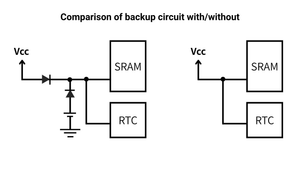
Adopting non-volatile memory can provide greater flexibility in circuit and system design. Eliminating the need for backup batteries or large-capacity capacitors for data retention enables physical board miniaturization and maintenance-free operation. Furthermore, increased resilience against power supply voltage fluctuations enhances operational stability in unstable power environments. This is paving the way for applications that were previously difficult to realize due to power constraints—such as implantable medical devices and AI systems operating in extreme environments like space or the deep sea.
Future Trends in Memory Development and Key Factors for Technology Selection
For future Edge AI applications, “scalability”—the ability to keep pace with processor advancements—is crucial to ensure that memory performance does not become a system bottleneck. Technological developments aimed at overcoming physical limitations are currently underway, including support for finer process nodes and bandwidth expansion through 3D stacking technologies. When selecting memory, it is essential to scrutinize parameters related to mass-production quality—such as whether ECC (Error Correction Code) is implemented, operating temperature ranges, and long-term supply availability—rather than relying solely on datasheet speed specifications. A comprehensive assessment that considers the system’s total lifecycle cost is indispensable.
Latest Architectures and Challenges for Design Engineers
Design engineers should currently focus on the trend of “heterogeneous integration,” where the boundaries between memory and logic are becoming increasingly blurred. While the adoption of technologies like CiM (Compute-in-Memory) and chiplets increases design complexity, the resulting performance gains are dramatic. However, adopting new memory technologies presents challenges, such as cases where existing testing methods are inapplicable or standardized interfaces are not yet established. This is where engineers’ implementation skills are put to the test—managing verification risks while delivering a stable, production-ready product.
RAMXEED FeRAM Product Lineup
RAMXEED ReRAM Product Lineup