Selecting Memory for Fast Startup: Devices That Overcome Write Cycle Limits
Devices should be ready to use immediately after power-on.
Fast startup is a basic expectation for many users of IoT devices and automotive systems.
Startup delays translate directly into user stress and dissatisfaction.
In practice, however, the system must copy configuration and log data from non-volatile memory to RAM, which lengthens startup. EEPROM and flash memory also have a limited write endurance, so the system needs control logic to avoid unnecessary writes.
The recommended memory for addressing these issues is FeRAM (also known as FRAM or ferroelectric RAM).
This article explains memory selection for fast startup. It also describes why FeRAM not only shortens startup time but also improves system design flexibility.
How Configuration Data Affects Startup Wait Time
Device startup time is the time from power-on until the user can operate the device. Users generally accept a certain amount of startup time, but the shorter the wait, the less stress they feel.
CPU processing speed alone does not determine this time. Design decisions about where to store configuration data and how to read it have a major effect on startup wait time.
The Role of Configuration Data Loading in the Startup Sequence
Between power-on and the point when the user can operate the device, the device runs several initialization processes in sequence.
Among these, loading configuration data sets the preconditions for all subsequent processing. This data includes items such as communication parameters, operating modes, and calibration values.
This step often comes early in the startup sequence. Later processes cannot start correctly until loading is complete.
This is why the speed of loading configuration data affects total startup time.
The Impact of Flash Memory Copying on Startup Time
Many devices use flash memory to store configuration data. However, flash memory writes slowly and has a limited number of write cycles, so it is not well suited to frequent updates.
Flash memory also cannot overwrite data directly, which makes it unsuitable for managing frequently changing configuration data.
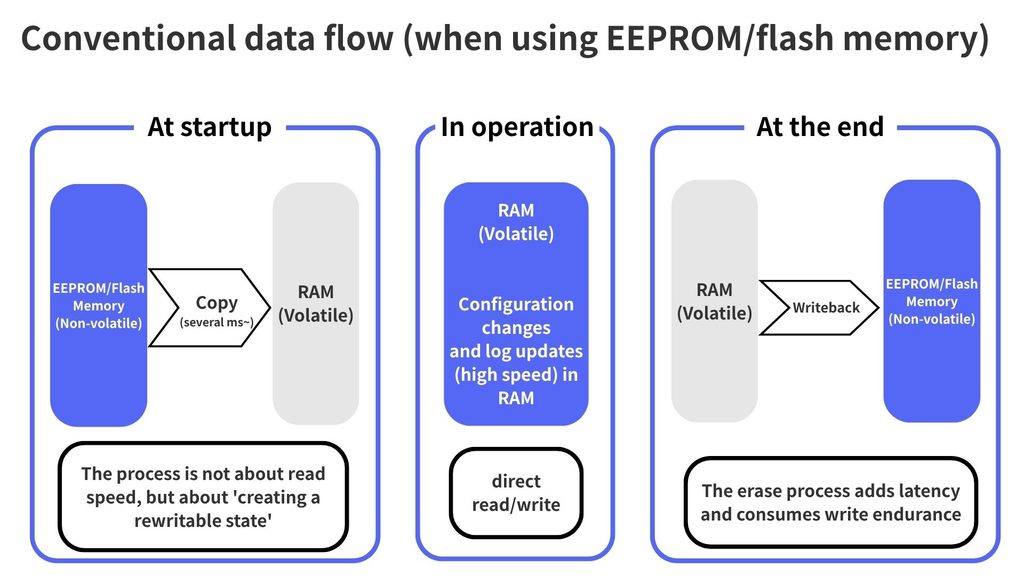
To work around this, systems typically copy the relevant data from flash memory to RAM at startup. The copy time depends on data size and read speed. It can run from tens to hundreds of milliseconds, which adds to startup wait time.
Conventional Approach: Temporary Loading into RAM
Temporarily loading data from flash memory into RAM has been widely adopted because it is a practical way to work around read and write speed problems.
However, this method comes with a secondary challenge: RAM space must be allocated for the loaded data.
Changes made in RAM are also lost when power is cut. To counter this, the system must write the changes back to flash memory every time they occur.
The architecture avoids the speed problem but takes on a different control issue.
Design Challenges Posed by Write Cycle Limits
In addition to startup time problems, flash memory and EEPROM have another major constraint.
That constraint is the upper limit on write cycles, which designers must keep in mind from the start of the design process.
Designing around write cycle limits not only complicates control logic but can even restrict the functionality the system was originally meant to provide.
Flash Memory Write Cycle Limits and Wear Leveling
Flash memory typically has a write cycle limit of tens of thousands to hundreds of thousands of cycles. When writes concentrate on the same address, that area degrades sooner than the rest.
Wear leveling, which spreads writes across different memory locations, is widely used to prevent this degradation. However, it requires control logic to manage write destinations, which adds implementation complexity.
Increased Control Logic Complexity and Firmware Design Challenge
Handling write cycle limits affects firmware design as well as hardware design.
In addition to wear leveling, the system needs erase operations before writes, error correction, and data protection during power loss. Combining these processes increases the amount of code.
This also increases debugging effort. It is not uncommon for control logic that was not anticipated early in the design to be retrofitted after mass production begins.
Limits in Applications with Frequent Configuration Changes and Log Updates
Some applications handle frequently updated data, such as sensor calibration values and user settings. In these applications, reaching the write cycle limit is a real concern.
This concern is especially pronounced in industrial and automotive equipment designed for long-term operation. In some cases, the available write cycles fall short of the expected product lifetime.
As a result, engineers are sometimes forced to limit update frequency, which runs counter to the original functional requirements.
Eliminating Bottlenecks by Switching to FeRAM
Flash memory and EEPROM are useful non-volatile memories used in many devices. However, as discussed above, both have problems with startup sequence time and write cycle limits. These are true design bottlenecks.
FeRAM offers a fundamentally different approach to these challenges.
FeRAM is non-volatile, yet it operates at speeds comparable to RAM. This combination of characteristics shortens startup time and reduces the design load at the same time.
FeRAM: Non-Volatile Memory with High-Speed Access
FeRAM is non-volatile memory that offers access speeds approaching those of SRAM. It stores data using the polarization state of a ferroelectric material, so it does not need the erase operation that flash memory requires.
Thus, a write is completed in a single access. This opens up new options for handling configuration data.
How Eliminating the RAM Loading Step Shortens Startup Time
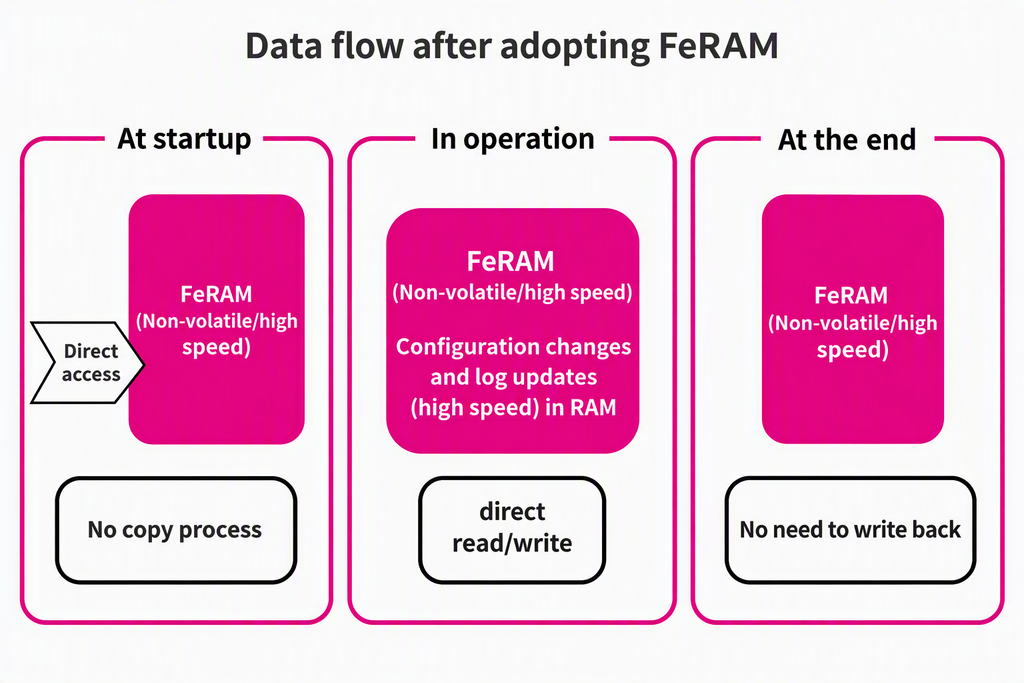
Storing configuration data in FeRAM makes it easier to adopt an architecture that skips the copy step at startup.
This reduces the copy wait time of conventional methods and should shorten configuration data load time.
Shifting to Designs That Do Not Need to Account for Write Cycle Limits
FeRAM typically supports 1 trillion to 100 trillion write cycles.
That is orders of magnitude higher than flash memory’s limit, so in practice designs no longer need to account for write cycle limits.
Control logic such as wear leveling and write-back processing is no longer necessary.
The firmware structure can stay simple.
Fast Startup Increases Design Flexibility
Memory selection is more than a performance comparison. It has a major effect on the overall system architecture and software design. Choosing FeRAM allows for both fast startup and high endurance, and it should also improve design flexibility and maintainability.
For future embedded devices, selecting memory with the entire system in mind can contribute to more efficient, flexible, and robust system designs, leading to the development of highly competitive products.
RAMXEED FeRAM Product Lineup