CMOS Technology and EEPROM: Design and Applications of High-Performance Non-Volatile Memory
By manufacturing EEPROM using CMOS technology, it is possible to achieve high-performance, low-power non-volatile memory. This article covers key applications in embedded systems, medical devices, and the automotive industry, as well as key design considerations.
Fundamentals of EEPROM
What is EEPROM?
EEPROM (Electrically Erasable Programmable Read-Only Memory) is a type of non-volatile memory in which data can be electrically reprogrammed. Unlike conventional EPROM, EEPROM can erase data without ultraviolet light, which makes it more convenient. It is used in a wide range of electronic devices, including embedded systems and BIOS.
History and Development of EEPROM
The history of EEPROM dates back to the 1970s. Early versions were expensive and had a limited number of rewrite cycles; however, technological advancements have since reduced costs and improved write endurance. In particular, the adoption of CMOS technology has led to lower power consumption, making EEPROM well-suited for mobile and IoT devices.
Basic Operating Principle of EEPROM
EEPROM stores data using floating-gate transistors. By applying a voltage, electron flow is controlled and data write and erase operations are performed. Because byte-level access is supported, partial data updates are also possible, enabling flexible data management.
CMOS Technology and EEPROM
Overview of CMOS Technology
CMOS (Complementary Metal-Oxide-Semiconductor) is a semiconductor technology that enables the design of highly integrated circuits with low power consumption. Combining PMOS and NMOS transistors minimizes power consumption except during switching, which makes CMOS well-suited for energy-efficient device design.
Impact of CMOS Technology on EEPROM
With the introduction of CMOS technology, the power consumption of EEPROM has significantly reduced, and durability and data retention capabilities have improved. Furthermore, with advances in process miniaturization, storage capacity has increased enabling further miniaturization and higher density integration.
Advantages and Characteristics of EEPROM
The main advantages of EEPROM include low power consumption, high-speed data access, and high write endurance. These characteristics play a crucial role in next-generation smart devices.
Applications of EEPROM
Use in Embedded Systems
In embedded systems, EEPROM is used to store firmware and record configuration data. Because EEPROM operates at low power consumption, it is also suitable for battery-powered devices. Moreover, since in-system data updates are supported, system flexibility is enhanced.
Use in Medical Devices
In medical equipment, EEPROM is used for patient data storage and sensor data logging. EEPROM is employed in critical devices such as pacemakers and insulin pumps because it offers high reliability and long-term data retention. This advancement is driving the digitalization of healthcare.
Applications in the Automotive Industry
In automotive Electronic Control Units (ECUs), EEPROM is used for engine control, brake systems, navigation systems, and other applications. Recently, improvements in temperature tolerance and vibration immunity have enabled stable operation even in harsh environments. In particular, as autonomous driving technology advances, high-speed data processing and stability are increasingly required for non-volatile memory.
Conclusion
Future Outlook for EEPROM
In the future, EEPROM will continue to advance toward greater further miniaturization and higher density, evolving into higher-performance non-volatile memory. As AI and 5G technologies develop, new applications are expected to emerge as well.
Recommendations for Engineers
For engineers it is important to understand the characteristics of EEPROM and perform optimal design. Choosing technologies that optimize power consumption and improve write endurance is particularly important.
Latest Research Trends
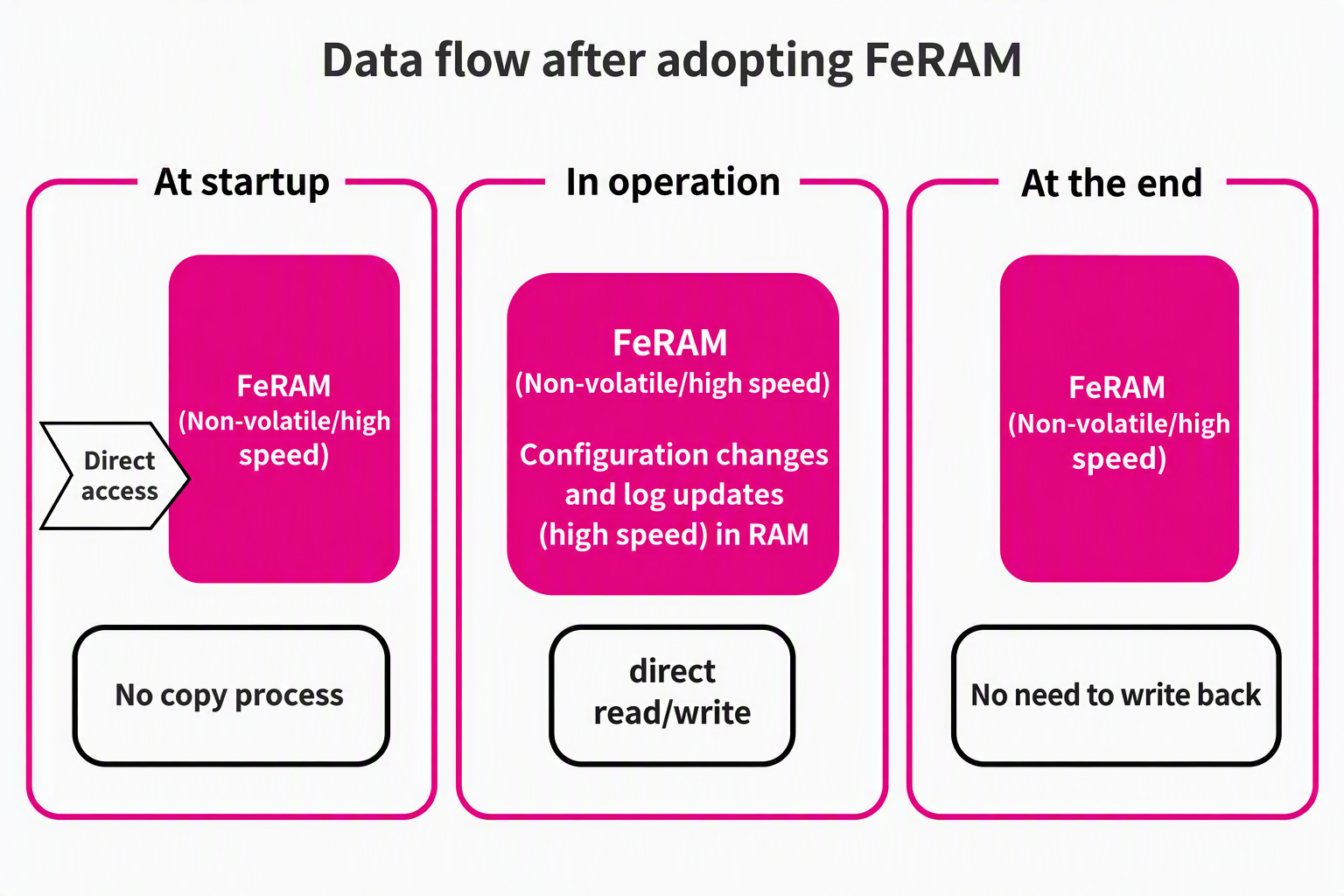
While technologies such as FeRAM (also known as FRAM), ReRAM, and MRAM are currently being researched as next-generation non-volatile memory solutions, EEPROM continues to hold an important position. As applications become more sophisticated, the specifications required of non-volatile memory will become more demanding. EEPROM and next-generation non-volatile memory will likely each be used across many fields, depending on the application.