Asynchronous SRAM: Fundamentals, Design Challenges, and Memory Selection Beyond the Limits of Volatility
This article describes the basic structure, operating principles, and technical advantages of asynchronous SRAM, and explains challenges such as data retention through power loss and backup-circuit design. Furthermore, it discusses the differences between asynchronous SRAM and FeRAM (FRAM, ferroelectric memory), and explains key considerations for memory selection depending on the application.
Asynchronous SRAM Basic Structure and Operating Principles
SRAM is a semiconductor memory that holds data using transistor circuits. Due to its high-speed random access performance, it is widely used as high-speed memory alongside processors. Asynchronous SRAM, in particular, is characterized by its ability to directly read and write data according to the state of address and control signals, without using a clock signal.
Data Storage in the Six-Transistor (6T) Cell
SRAM generally uses memory cells composed of six MOS transistors to hold data. The cell holds each bit in a flip-flop formed by two cross-coupled inverters and connects to the bit lines through two access transistors. This structure eliminates the need for refresh operations for data retention, enabling high-speed reads. On the other hand, if the power supply is interrupted, the held data is lost, so its characteristics as volatile memory must be considered for long-term storage applications.
Timing Design of Asynchronous Interfaces
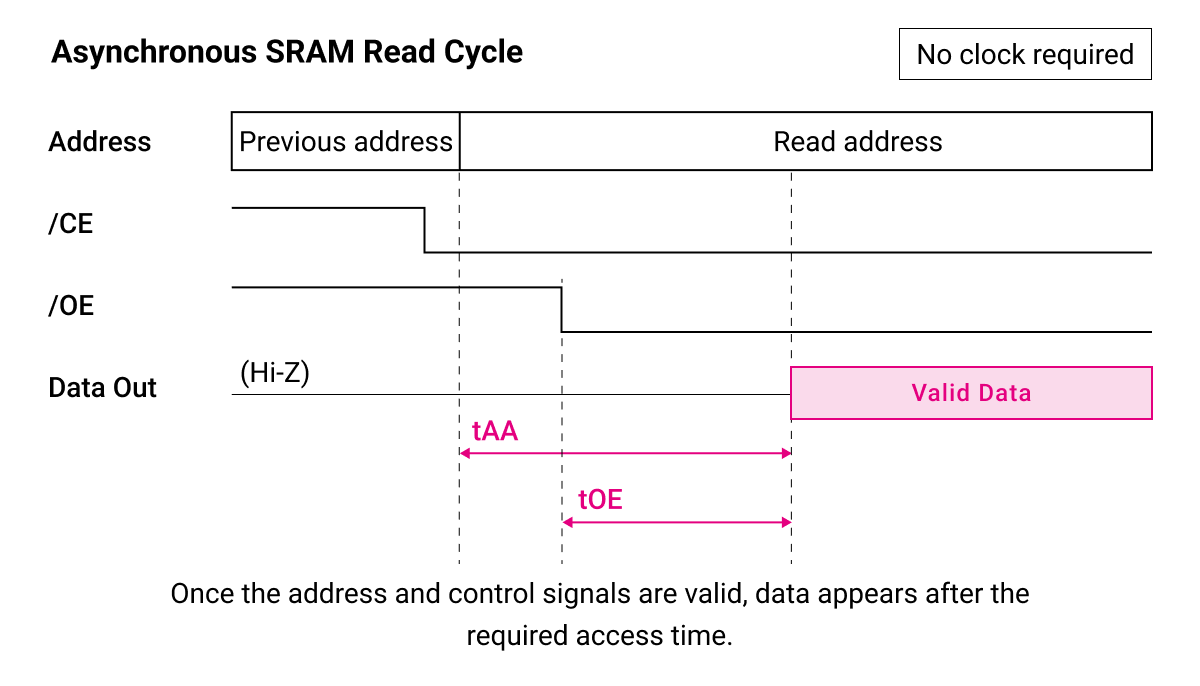
Asynchronous SRAM does not use a clock signal; memory access is performed in response to changes in address and control signals. Main control signals include chip enable (CE), output enable (OE), and write enable (WE), and read/write operations are determined by the timing of these signals. This approach enables low-latency access because there is no clock synchronization constraint, but system designers must accurately meet timing specifications such as address setup time and data hold times.
Architectural Comparison with Synchronous SRAM
Synchronous SRAM is a memory that operates synchronously with a clock signal and is suitable for connection to processors with high-speed bus interfaces. Asynchronous SRAM, on the other hand, does not require a clock and can be accessed using address and control signals only, resulting in a relatively simple interface. Therefore, asynchronous SRAM is widely used in embedded devices and control systems. However, because synchronous SRAM supports pipelined operation and burst access, the synchronous type can be advantageous in very high-speed systems.
Technical Advantages of Asynchronous SRAM
Asynchronous SRAM, combining a simple interface with high-speed access performance, is used in many embedded systems such as industrial equipment and communication devices. Because clock synchronization is not required, it offers high design flexibility and enables low-latency data access.
Low Latency and High-Speed Random Access Performance
One of the major features of asynchronous SRAM is its low-latency random access performance. When an address signal is input, the internal circuitry immediately begins data access without waiting for the clock. Therefore, access latency is small, making it suitable for systems requiring real-time performance. This low-latency characteristic plays a particularly important role in cache buffers and high-speed data processing circuits. Furthermore, because of its simple cell structure, read speeds are stable, and it exhibits excellent performance not only for sequential access but also for random access.
Design Advantages of a Simple Control-Signal Interface
Asynchronous SRAM has a simple interface that operates using an address bus, a data bus, and a few control signals. Generally, read and write operations are controlled by combining signals such as CE, OE, and WE. This structure allows for relatively easy connection to microcontrollers and FPGAs. In addition, since no clock-domain crossing needs to be managed, design complexity is reduced. The simple interface is a significant advantage in terms of increasing system design flexibility.
Suitability for Real-Time Processing Applications
In industrial equipment, communication devices, and measurement systems, real-time performance—the ability to reliably process data within a specified time—is crucial. Asynchronous SRAM has the advantage of predictable access latency because it eliminates clock synchronization latency. Therefore, it is suitable for applications where timing determinism is required, such as control devices and buffer memory. Furthermore, the relatively simple access timing makes latency estimation easier during system design, which is another advantage.
Limitations of Asynchronous SRAM and Comparison with FeRAM
While asynchronous SRAM excels in high-speed access performance, its volatile nature imposes design constraints. Data retention during power loss and backup circuits are major factors for system design.
Data Retention During Power Loss – Differences from FeRAM
Because asynchronous SRAM is a volatile memory, data is lost when the power supply is interrupted. Therefore, systems that need to retain data during power loss require the use of backup power supplies or other non-volatile memory. On the other hand, FeRAM is a non-volatile memory that uses ferroelectric materials to retain data, and it has the advantage of retaining information even without power. This difference is one of the main design considerations in applications where data protection during power failure is crucial, such as log storage and configuration data retention.
Comparison of Backup Circuit Design and System Complexity
To preserve asynchronous SRAM contents through power loss, designs sometimes add backup power sources such as supercapacitors or batteries. However, these additional circuits can lead to an increased board space, higher component costs, and added maintenance burden of replacing depleted batteries. Power management circuits and voltage monitoring circuits may also be required, complicating the overall system design. In contrast, non-volatile memory like FeRAM can retain data even during power loss, enabling an extremely simple hardware configuration that does not require peripheral backup circuits.
Technical Differences in Power Consumption and Write Endurance
While asynchronous SRAM offers high-speed access, it requires continuous power supply to retain data. Therefore, power consumption can be a challenge during long standby periods. Furthermore, it is common to use separate non-volatile memory for data storage applications. On the other hand, FeRAM is known for its low power consumption while and high write endurance. These differences in characteristics are important considerations for applications involving frequent writing, such as log recording and configuration data storage.
Memory Selection: Asynchronous SRAM vs. Non-Volatile Memory
When selecting memory devices, it is necessary to comprehensively evaluate not only speed and capacity, but also power supply conditions, data retention requirements, power consumption, and other factors. Asynchronous SRAM and non-volatile memory each have different characteristics, so it is important to select and use them appropriately according to the intended system purpose.
When High-Speed Volatile Memory Is the Optimal Choice
Asynchronous SRAM is suitable for applications that require high-speed random access and low latency. For example, in external processor caches, high-speed buffers, and data processing memory, access speed directly affects system performance, thus prioritizing speed—even if the memory is volatile—can improve overall system performance. In addition, its simple interface makes it widely used and straightforward to design within embedded systems.
When to Consider Non-Volatile Memory
In systems that need to retain data even during power loss, it is important to consider the use of non-volatile memory. For applications such as configuration data, log information, and measurement results, data loss due to power loss must be prevented. In this situation, non-volatile memory, including FeRAM, becomes a n advantageous option. It applies especially to applications requiring high-speed write performance and high write endurance, where memory technologies with fundamentally different characteristics from conventional flash are worth evaluating.
Memory Selection Guidelines for System-Wide Optimization
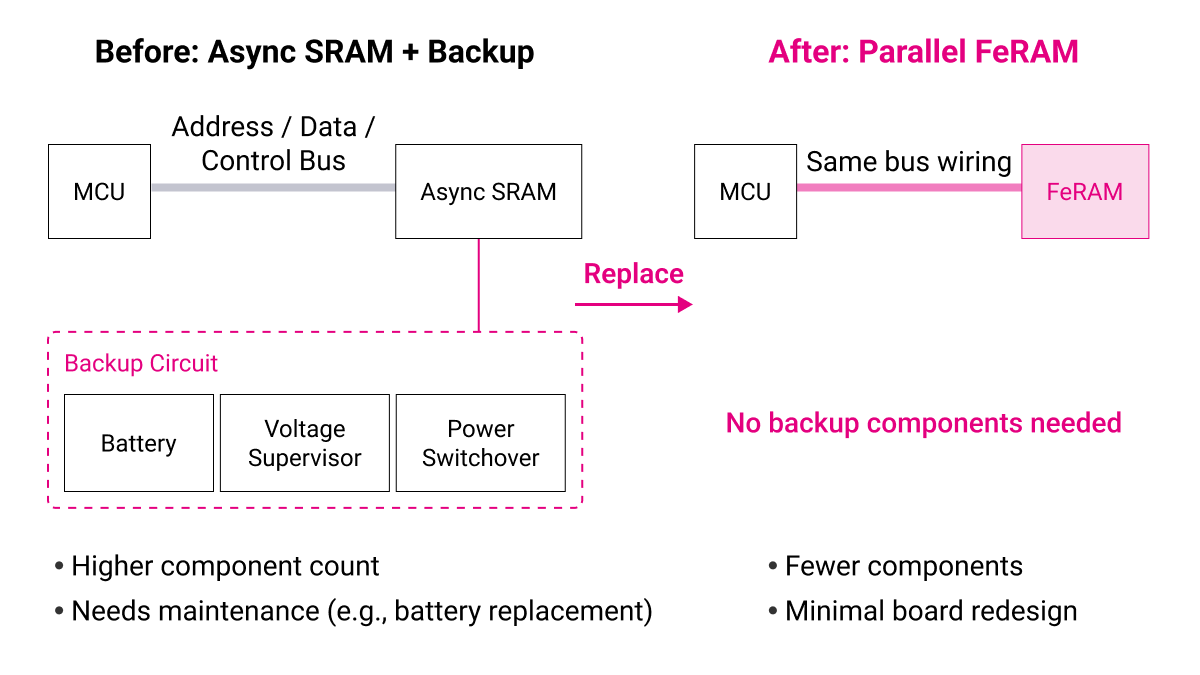
To select the optimal memory, it is necessary to comprehensively evaluate multiple factors such as speed, power consumption, data retention, and durability. When it is difficult for a single memory to fulfill all requirements, an architecture combining volatile and non-volatile memory may be used. In addition, since parallel FeRAM is pin-compatible with asynchronous SRAM, existing bus routing can be reused, and only a minimal board revision is needed to remove now-unnecessary backup components such as batteries and capacitors—significantly reducing design effort and component count while making the system non-volatile.
RAMXEED Parallel Interface FeRAM Family