What Is nvSRAM? Characteristics and Alternative Memory Technologies
nvSRAM combines the high-speed access performance of SRAM with the ability to retain data after power loss. This article explains its architecture, technical characteristics, and differences compared with MRAM and FeRAM.
Structure and Data Retention Mechanism of nvSRAM
nvSRAM combines the high-speed random-access performance of volatile SRAM with the data retention capability of non-volatile memory in a single device. During normal operation, it behaves like a standard SRAM, allowing existing software and hardware designs to be used with minimal modification. When a power interruption or power failure occurs, dedicated internal circuitry transfers the data stored in SRAM to a non-volatile storage area. This enables the system to restore its previous state after power is restored, making nvSRAM suitable for applications requiring high reliability, such as industrial equipment and control systems.
Integrated Architecture of Volatile SRAM and Non-Volatile Memory
Externally, nvSRAM appears as an SRAM-compatible memory device, using the same addressing and read/write methods as conventional SRAM. Internally, it integrates a high-speed SRAM cell array with a non-volatile memory area used to preserve data during power loss. Under normal operating conditions, only the SRAM array is accessed, eliminating the write latency and erase requirements associated with flash memory. The non-volatile memory is used only during power-related events, allowing data retention functionality to be added without affecting real-time performance.
STORE/RECALL Mechanism During Power Loss
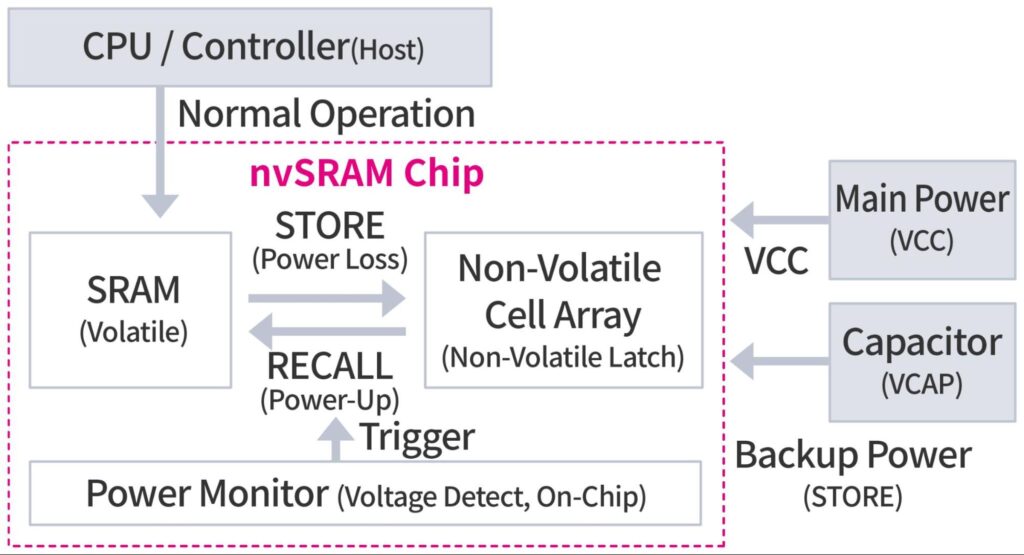
nvSRAM incorporates automatic data transfer functions known as STORE and RECALL. The STORE operation is triggered automatically when a drop in supply voltage is detected, transferring all data from the SRAM array to the non-volatile memory area. The RECALL operation occurs when power is restored, copying the saved data back into the SRAM array. So the system can resume exactly where it left off before power loss. Because these functions are handled entirely within the device, no special save or restore routines are required on the host side.
Data Storage Technology Using Internal Flash Memory
The non-volatile storage area in nvSRAM typically uses internal flash memory or EEPROM technology. These memory technologies can retain data for extended periods, even when power is completely removed. However, they are not intended for user-controlled random write operations. Instead, they serve as a backup storage area for the contents of the SRAM array. As a result, concerns such as flash endurance limits and memory management complexity are significantly reduced. This makes the architecture particularly suitable for reliability-focused industrial applications.
Key Technical Characteristics of nvSRAM
The primary advantage of nvSRAM is its ability to combine high-speed memory access with non-volatile data retention. While conventional non-volatile memories may introduce write delays or erase operations that affect system performance, nvSRAM avoids these limitations during normal operation. However, capacity and cost constraints must also be considered when selecting the appropriate memory technology for a given application.
High-Speed Read/Write Performance in the Tens of Nanoseconds Range
Because nvSRAM operates as SRAM during normal system operation, read and write accesses are completed within tens of nanoseconds. This makes it suitable for storing frequently updated variables within control loops and for retaining control parameters in systems with strict real-time requirements. Unlike flash memory or EEPROM, nvSRAM does not require software to manage write completion delays or special access sequences. As a result, software design can be simplified and worst-case response times can be more accurately predicted, improving the stability of real-time control systems.
Reliable Data Retention Without a Battery
Traditional battery-backed SRAM solutions require battery life management and periodic replacement, creating maintenance and reliability concerns. nvSRAM eliminates the need for an external battery by transferring data to internal non-volatile memory. However, the power supply must remain available long enough for the data transfer operation to complete, which requires a separately provided external capacitor connected to the nvSRAM. While this approach reduces the risk of unexpected data loss caused by battery degradation, designers must consider the reliability of the capacitor itself, including degradation under high-temperature operating conditions and other related reliability concerns.
Suitability for Industrial Applications: Operating Temperature and Endurance
Many nvSRAM products are designed specifically for industrial environments, offering wide operating temperature ranges and high reliability. Since the SRAM array handles frequent write operations during normal use, while the non-volatile storage area is written only during power-loss events, practical write endurance can be maintained over long operating lifetimes. These characteristics make nvSRAM a solid choice for control equipment, measurement systems, and infrastructure applications that require long-term stable operation.
Selection Considerations Compared with Other Non-Volatile Memories
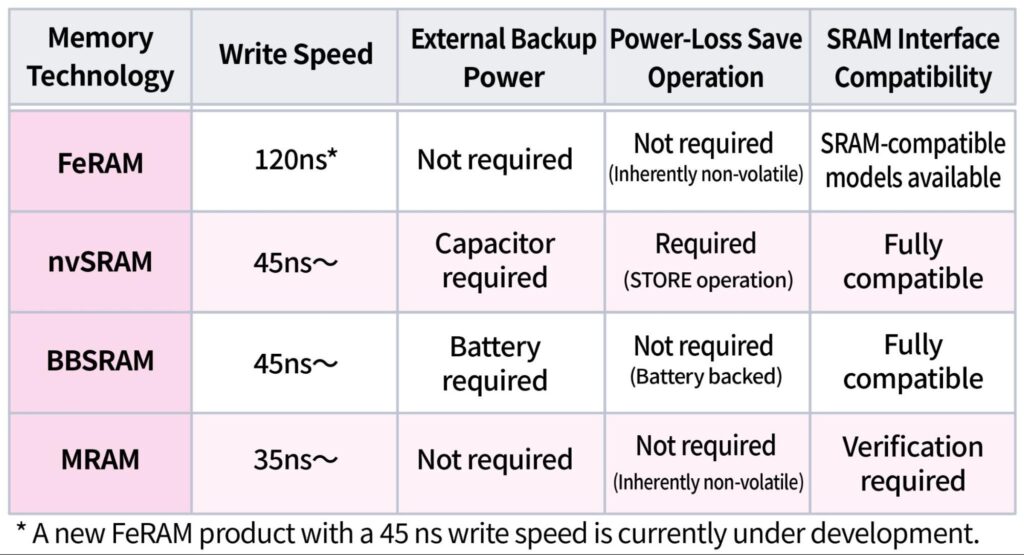
Although nvSRAM provides both high-speed operation and non-volatility, it is not necessarily the best choice for every application. Designers should evaluate alternatives such as battery-backed SRAM, MRAM, and FeRAM based on power-loss behavior, required capacity, cost, and implementation constraints. In particular, the success of data retention in nvSRAM depends on power-fall characteristics, which is a unique consideration compared with other memory technologies.
Structural and Operational Differences from Battery-Backed SRAM
Battery-backed SRAM retains data by supplying power to the SRAM array from a battery or capacitor when the main power source is removed. While this enables continuous data retention during power outages, it introduces operational burdens such as battery maintenance, replacement schedules, and storage requirements. In contrast, nvSRAM stores data in a non-volatile memory area when power loss occurs, eliminating the need for battery management. However, if the supply voltage drops too rapidly, the STORE operation may not complete successfully, making power-supply design and validation critical.
Endurance and Write-Speed Differences Compared with MRAM
MRAM is a non-volatile memory technology based on magnetic tunnel junctions that provides fast write speeds and high endurance while remaining continuously non-volatile. Because it does not require a backup operation during power loss, MRAM can offer advantages in data retention reliability. On the other hand, nvSRAM can be integrated into existing parallel SRAM designs with minimal architectural changes due to its SRAM-compatible interface. When comparing the two technologies, factors such as write performance, endurance, interface compatibility, cost, and long-term supply availability should all be considered.
Power Consumption and Cost Trade-Offs Compared with FeRAM
FeRAM is a ferroelectric-based non-volatile memory technology that offers low power consumption and fast write performance. Because no special backup operation is required during power-loss events, systems can be designed without considering power-failure save sequences. However, capacity ranges and process limitations may restrict its use in some applications. Although nvSRAM may be less favorable in terms of power consumption and cost in certain cases, it remains attractive for applications that prioritize SRAM compatibility and design simplicity. Designers should compare the two technologies based on capacity requirements, power budgets, and cost constraints.
Key Factors When Evaluating nvSRAM Adoption
When considering nvSRAM, designers should evaluate more than just its non-volatile characteristics. It is important to clearly define the type of data that must be retained and the expected conditions during power-loss events. The suitability of nvSRAM should be assessed within the context of the overall system requirements.
Selection Criteria Based on Data Retention Requirements
The first step is identifying which data must be preserved, such as configuration settings, learned parameters, and accumulated counters, and determining the impact if that data is lost. Update frequency, acceptable data loss levels, and the expected frequency of power interruptions should then be evaluated to determine whether the nvSRAM backup mechanism satisfies system requirements. Documenting these requirements helps provide an objective basis for memory selection.
Implementation Considerations in Circuit Design
When using nvSRAM, the supply voltage decay profile directly affects whether the STORE operation can complete successfully. As a result, careful design of power-monitoring thresholds and decoupling capacitance is required. Designers must also ensure that the RECALL operation does not conflict with system initialization or reset sequences during power-up. Meeting these conditions is essential to achieving the expected data retention performance in actual hardware.
Application-Specific Evaluation Criteria for nvSRAM Adoption
nvSRAM is particularly effective in applications that require both high-speed memory access and state retention. It is well-suited to industrial control systems and communications equipment. However, in applications with strict cost constraints or large memory capacity requirements, alternative non-volatile memory technologies may be more appropriate. Adoption decisions should be based on a clear understanding of application requirements and an assessment of whether nvSRAM provides measurable value at the system level.