Inside RAMXEED ULTIMATE: The Technologies Behind Guaranteed 125°C, 10-Year Data Retention
There is growing demand for memory that can simultaneously achieve long-term data retention in high-temperature environments and frequent write operations. RAMXEED’s Ferroelectric random access memory (FeRAM) has continued to evolve to meet this challenge.
Toward Memory That Reliably Retains Data Even in High-Temperature Environments
FeRAM is a nonvolatile memory that can retain data even when power is turned off. In addition, it offers high-speed write capability, low power consumption, and extremely high endurance, making it uniquely capable of achieving both “frequent writing” and “reliable retention.”
The FeRAM business traces its origins to 1999, when Fujitsu pioneered the mass production of FeRAM. Since then, it has been continuously inherited and developed by engineers and business teams responsible for development, manufacturing, and sales. RAMXEED carries on this legacy and provides FeRAM products based on more than 25 years of accumulated technology and experience. With a cumulative shipment volume exceeding 4.4 billion units and adoption in more than 60 countries, FeRAM is widely used worldwide as a highly reliable memory supporting social infrastructure.
Traditionally, FeRAM has been used in applications such as electricity meters, water meters, and office equipment, where operation within typical environmental temperatures (–40°C to 85°C) is required. However, in recent years, the demand for use in harsher environments—such as factory equipment and automotive systems—has been rapidly expanding. In particular, the ability to retain data over long periods in high-temperature environments, such as near car engines or inside equipment, has become a critical requirement. To address these needs, RAMXEED has developed FeRAM capable of long-term data retention at 125°C.
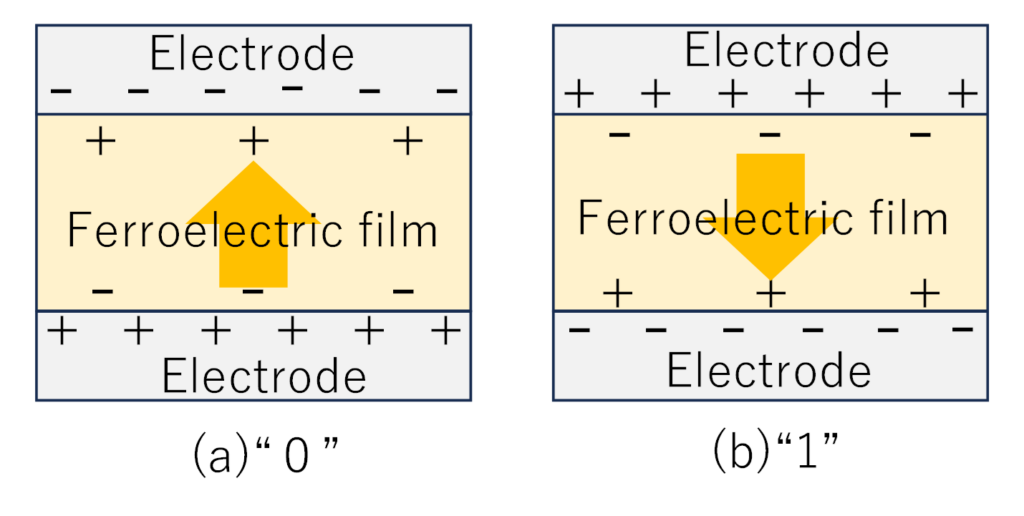
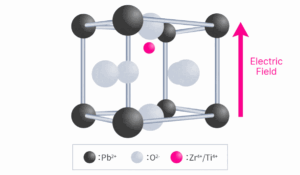
Fig. 1 Cross-sections and polarization directions of ferroelectric capacitors written as (a) “0” and (b) “1”.
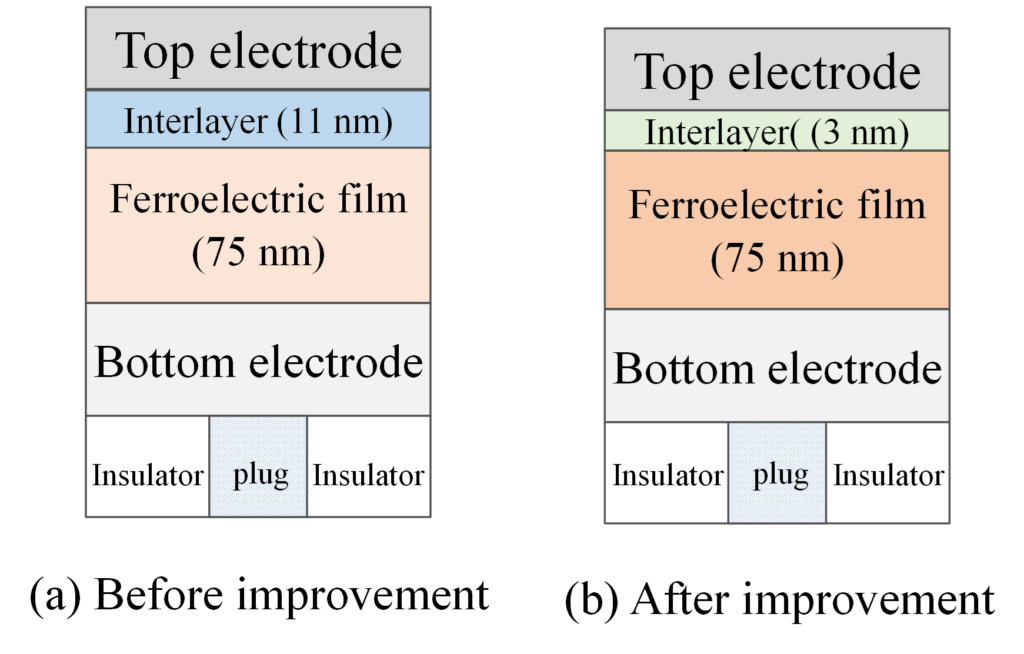
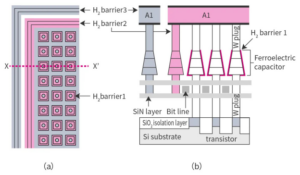
Fig. 2 Cross-sections and polarization directions
Two Key Technologies Supporting Data Retention Performance
This high-temperature-capable FeRAM has been developed through both materials technology and circuit design innovations.
First is the improvement of the ferroelectric capacitor, which is the core of FeRAM [1]. In FeRAM, information “0” and “1” is stored as polarization states (Fig. 1). The ferroelectric capacitor consists of a ferroelectric material sandwiched between top and bottom electrodes (Fig. 2), and information is written by applying voltage to polarize the ferroelectric material. In this development, the deposition conditions of the ferroelectric material were optimized to improve material quality, and the interface structure between the electrode and ferroelectric layer was refined. In particular, by optimizing the thin film layer introduced at the interface, mutual diffusion of elements is suppressed, enabling stable maintenance of polarization states over long periods.
Another key technology is the development of a ferroelectric SPICE model. RAMXEED has created a proprietary model that accurately reproduces ferroelectric polarization behavior based on measured data. This model considers not only polarization characteristics but also data variability, enabling verification at the circuit design stage that sufficient operating margins are ensured even after 10 years at 125°C.
In other words, long-term reliability is achieved by optimizing materials and design in an integrated manner.
Demonstrated High-Temperature Reliability
The developed FeRAM has been evaluated over a wide temperature range from –45°C to 125°C. *
Under stringent conditions—writing “0” and “1” and reading at a voltage (1.65 V) lower than the actual operating voltage (1.8 V)—sufficient read margins were confirmed across the entire temperature range (Fig. 3). While conventional products tend to show reduced margins at higher temperatures, the improved version exhibits stable read characteristics with minimal temperature dependence.
*The device is guaranteed for operation from −40°C to 125°C.
In addition, imprint, a characteristic issue specific to FeRAM, was evaluated. Imprint refers to a phenomenon in which, after maintaining the same polarization state for a long time, it becomes difficult to read when switching to the opposite state. In a high-temperature storage test at 150°C for 1,000 hours (equivalent to approximately 10 years), the read characteristics of “Opposite State (OS)”—reading after storing a “0” or reversing it to “1”—were evaluated. The results confirmed that the improved product maintains sufficient margins even in OS read operations (Fig. 4).
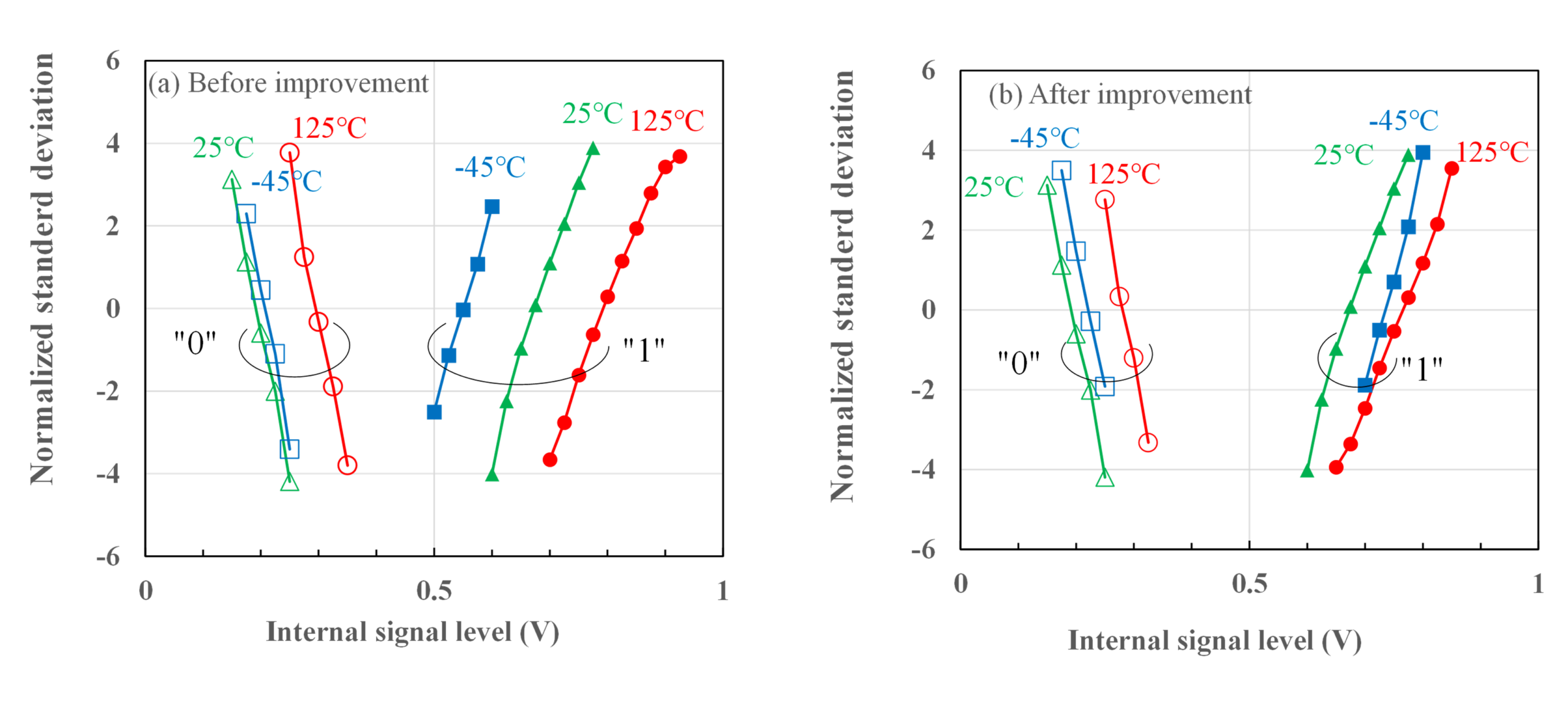
Fig. 3 Initial distributions of “0” and “1” data (a) before and (b) after improvement, obtained at −45°C, 25°C, and 125°C.
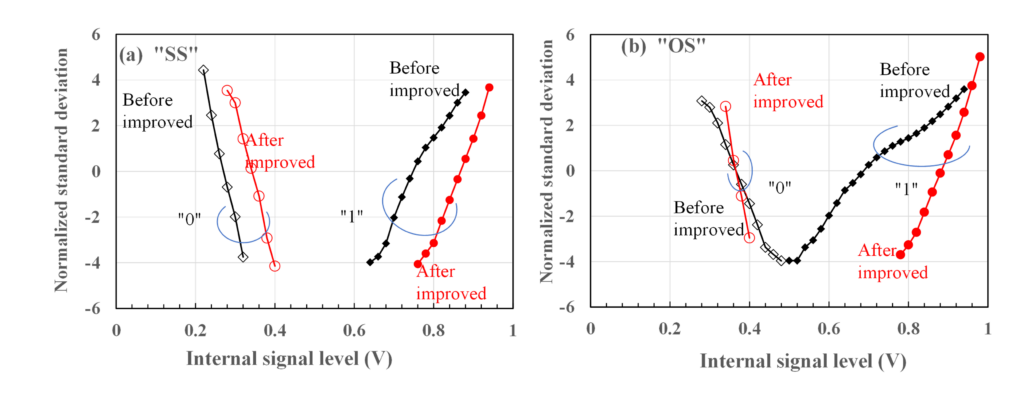
Fig. 4 Normalized distributions of (a) “SS” and (b) “OS” after baking at 150°C for 1000
The Value of “125°C, 10-Year Guarantee”
In nonvolatile memory, expressions such as “125°C compatibility” or “10-year retention” are commonly used, but in many cases these values are calculated based on mission profiles that assume actual usage conditions. That is, they are often derived under the assumption that the device is not continuously exposed to 125°C.
In contrast, RAMXEED’s FeRAM guarantees, as a product specification, data retention for 10 years under continuous exposure to a 125°C environment. This guarantee is based on evaluations under conditions close to real usage and does not depend on assumed operating profiles. It provides a reliable design basis not only for automotive applications but also for industrial equipment and infrastructure systems.
An Optimal Solution for High-Temperature and High-Frequency Applications
RAMXEED has commercialized this FeRAM as “RAMXEED ULTIMATE” [2]. These products are expected to be applied across a wide range of fields as memory solutions that combine long-term data retention in high-temperature environments with frequent write operations.
Summary
RAMXEED’s FeRAM is a highly reliable memory supported by more than 25 years of mass production experience.
The newly developed “RAMXEED ULTIMATE” achieve, in addition to conventional strengths, guaranteed data retention for 10 years at 125°C—an extremely demanding condition. This performance is realized through the integration of advanced ferroelectric capacitor materials and SPICE modeling based on measured data.
RAMXEED will continue to support system design across various fields through highly reliable nonvolatile memory.