Manufacturing Innovation in FeRAM: Protection Technology for PZT Ferroelectric Capacitors
Addressing the fragility of PZT crystal structures: Protection technologies for ferroelectric capacitors
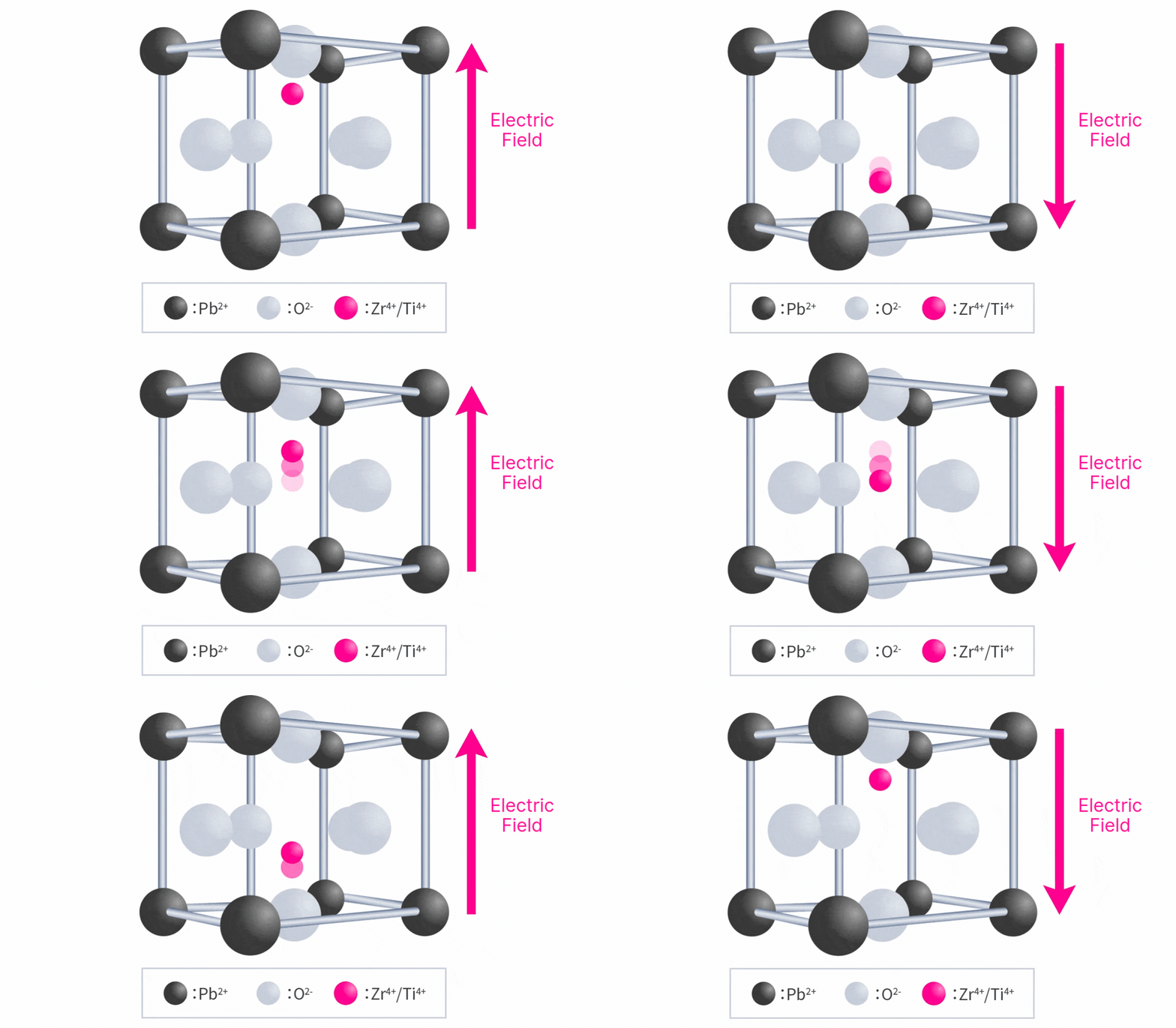
PZT ferroelectric films form the core of FeRAM, and ferroelectric capacitors based on these films serve as the memory elements. To ensure their stability during high-temperature processing in semiconductor manufacturing, various protection strategies were systematically investigated, ultimately establishing robust protection technologies.
Overview of the FeRAM Manufacturing Process
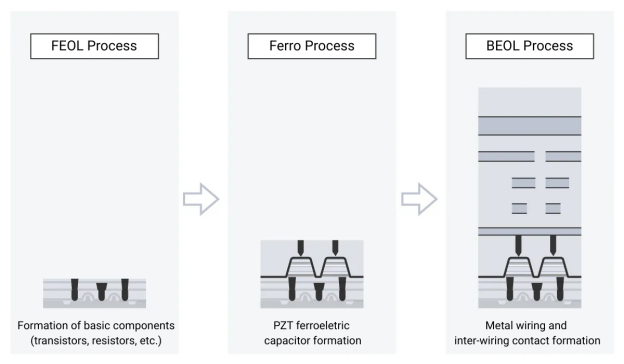
Figure 1. Schematic illustration of the FeRAM manufacturing process, showing the sequence of FEOL (Front End of Line), ferroelectric capacitor formation (ferro process), and BEOL (Back End of Line) integration.
The FeRAM(1) manufacturing process begins with the FEOL (Front End of Line), where fundamental device components such as transistors and resistors are formed. This is followed by the ferroelectric process, in which PZT(2) ferroelectric capacitors are fabricated. Finally, the BEOL (Back End of Line) process forms metal interconnects and interlayer vias, completing the device.
(1) FeRAM: Ferroelectric Random Access Memory
(2) PZT: lead zirconate titanate
Degradation of the PZT Crystal Structure
High-temperature processing steps in FeRAM manufacturing can degrade the PZT crystal structure. In particular, processing in high-temperature reducing atmospheres causes the in-diffusion of hydrogen and moisture. These species extract Pb and O atoms from the PZT crystal lattice, resulting in a disrupted crystal structure.
This structural degradation severely compromises the reliability and endurance of FeRAM and poses a critical challenge for manufacturing. During the early mass-production stage around 1999, this issue was especially severe, and the degraded PZT structure was colloquially described as “crumbling like tofu.”
Protection Strategies for PZT Ferroelectric Capacitors
To address these issues, two principal approaches were adopted to protect PZT ferroelectric capacitors. One approach enhances degradation resistance by optimizing the material and composition of the top electrode. The other improves degradation resistance by depositing protective films to encapsulate the ferroelectric capacitor.
1. Optimization of the Top Electrode Material
Replacing the top electrode material from platinum (Pt) with iridium oxide (IrOₓ) substantially improved resistance to hydrogen-induced degradation(4). Furthermore, optimizing the oxidation state of IrOₓ resulted in a more process-tolerant capacitor structure(5).
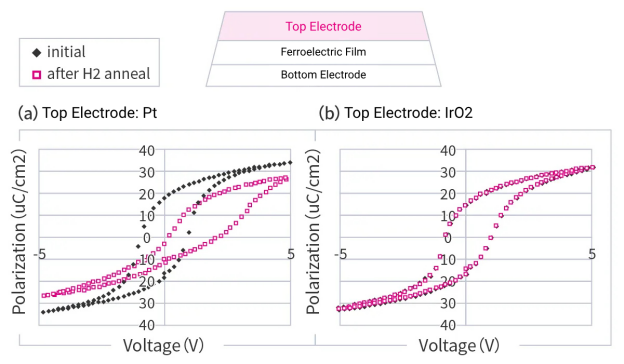
Figure 2. Polarization–voltage (P–V) hysteresis characteristics before and after hydrogen annealing (150 °C, 60 min, 3% H₂/N₂): (a) Pt top electrode, (b) IrO₂ top electrode.
Changing the top electrode material from Pt to IrO2 greatly improved resistance to hydrogen-induced degradation.
(4) Takai et al., “Development of 0.5 µm Ferroelectric Memory Using Sputtered PZT (2): Effects of Pb Concentration on IrO2/PZT/Pt Ferrocapacitor Characteristics,” Autumn Meeting of the Japan Society of Applied Physics, 2000
(5) Japanese Patent No. 4827653
2. Triple Hydrogen Barrier Structure
Encapsulating the PZT ferroelectric capacitor within a triple hydrogen barrier structure further enhanced resistance to hydrogen-induced degradation(6)(7). This technology enabled the fabrication of FeRAM with a capacitor area as small as 0.4 µm².
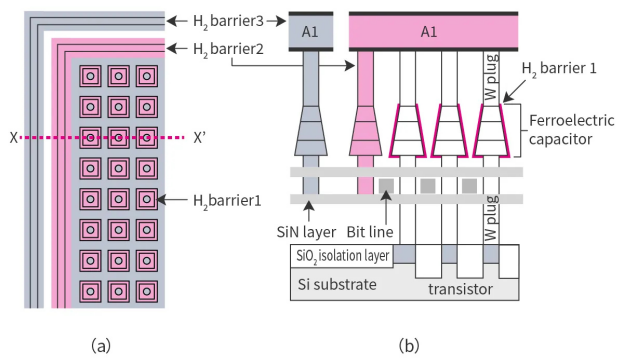
Figure 3. Schematic of the FeRAM cell with a triple hydrogen barrier structure. (a) Plan view. (b) Cross-sectional view along X–X’ in (a).
(6) H. Saito, T. Sugimachi, K. Nakamura, S. Ozawa, N. Sashida, S. Mihara, Y. Hikosaka, W. Wang, T. Hori, K. Takai, M. Nakazawa, N. Kosugi, M. Okuda, M. Hamada, S. Kawashima, T. Eshita, and M. Matsumiya, IEEE Int. Memory Workshop 2015
(7) Takashi Eshita, Wensheng Wang, Kenji Nomura, Ko Nakamura, Hitoshi Saito, Hideshi Yamaguchi, Satoru Mihara, Yukinobu Hikosaka, Yuji Kataoka and Manabu Kojima, “Development of Highly Reliable Ferroelectric Random Access Memory and its Internet of Things Applications”, Jpn. J. Appl. Phys Vol. 57, No.11S, pp. 11UA01-1-5, 2018
Improved Performance and Reliability
By combining these protection strategies, it became possible to fabricate FeRAM that retains its reliability even in high-temperature processing environments. As a result, FeRAM achieved enhanced performance, reliability, and commercial viability.
Summary
Protection of PZT crystal structures remains a critical aspect of FeRAM manufacturing. Through these technological advancements, we improved the performance and reliability of FeRAM and laid the groundwork for continued advancement in FeRAM technology.