Research and Development of HZO FeRAM for Higher-Capacity FeRAM
Beyond PZT FeRAM
FeRAM is an excellent memory technology with high write endurance, fast write speeds, and low write power consumption. However, increasing memory capacity remains a challenge. To address this, we are conducting research and development on FeRAM using a new ferroelectric material, HZO, to enable larger-capacity FeRAM devices.
PZT FeRAM Is a Superior Memory
PZT FeRAM (Lead Zirconate Titanate Ferroelectric Random Access Memory) is a superior memory technology with features such as high write endurance, fast write speed, and low write power consumption.
Its write endurance reaches 10^14 (100 trillion) cycles, which is orders of magnitude higher than other non-volatile memories such as NAND Flash, NOR Flash, EEPROM, ReRAM, and PCRAM. Its write speed is also faster than these non-volatile memories, achieving write times of less than 50 ns.
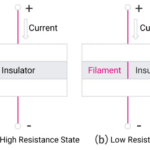
Write power consumption is lower than that of emerging non-volatile memories such as MRAM, ReRAM, and PCRAM. This is because PZT FeRAM does not rely on resistive switching mechanisms and does not require current to flow through the memory cell during writing. In contrast, memories such as MRAM, ReRAM, and PCRAM use resistive switching during write operations, which require current flow through the memory element. Since power consumption is proportional to voltage × current, this results in higher write power.
In addition, while MRAM relies on magnetism, PZT FeRAM does not use magnetic properties and therefore operates without restrictions even under strong magnetic fields. (Table 1)
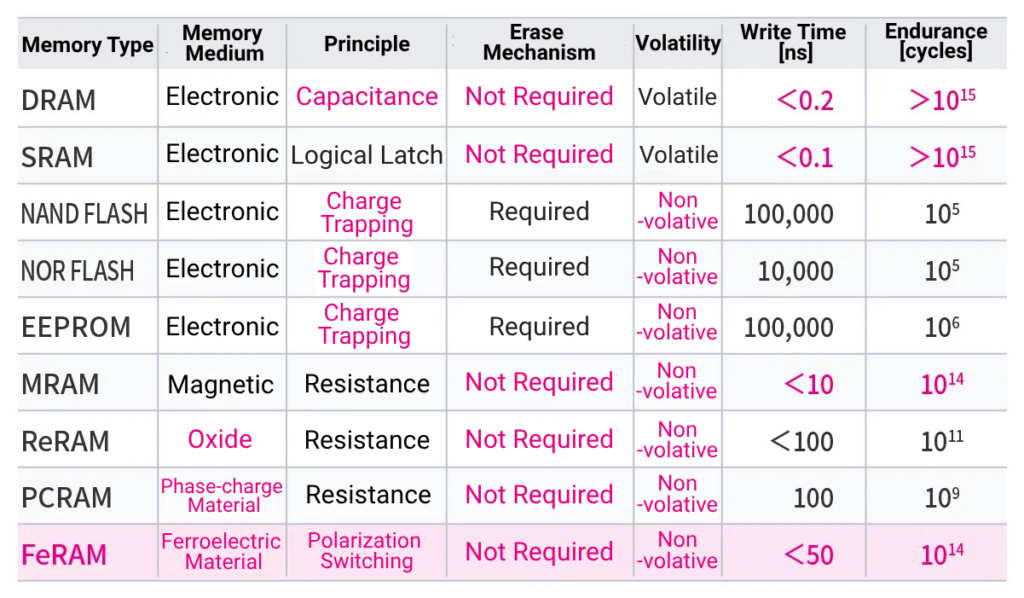
When the memory medium is charge-based, it is more susceptible to radiation effects; when it is magnetic-based, it is more susceptible to external magnetic fields. In contrast, oxygen-based, phase-change, and ferroelectric materials are inherently resistant to both radiation effects and external magnetic fields.
When the memory principle is resistive-based, current flows through the memory cell during write operations, increasing power consumption. In contrast, capacitance-, trapped-charge-, and polarization-based memories do not require current to flow through the memory cell during writing, giving them an advantage in write power consumption.
Memories that require write/erase on-chip charge pumps need high voltages exceeding 5V for write and erase operations, which increases power consumption. In contrast, memories that do not require such circuits can perform write operations below 2V without erase operations, resulting in lower power consumption.
Volatile memories require power to retain data, whereas non-volatile memories do not require power for data retention.
Among non-volatile memories, FeRAM offers the second-fastest write speed after MRAM.
FeRAM also provides high write endurance among non-volatile memories.
Capacity Scaling Is a Challenge for PZT FeRAM
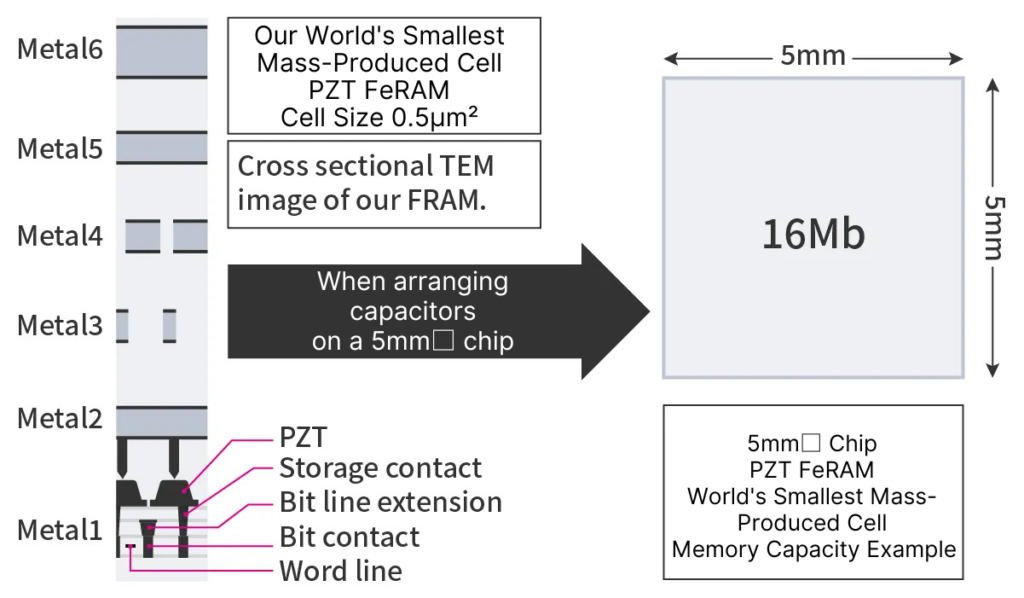
Although PZT FeRAM offers excellent features, it also has challenges. One of them is memory capacity scaling. When capacitors based on our mass-produced world-smallest PZT FeRAM cell with a cell size of 0.5 μm^2 are arranged on a 5 mm-square chip, the resulting memory capacity is 16 Mb (*1, *2). (Figure 1)
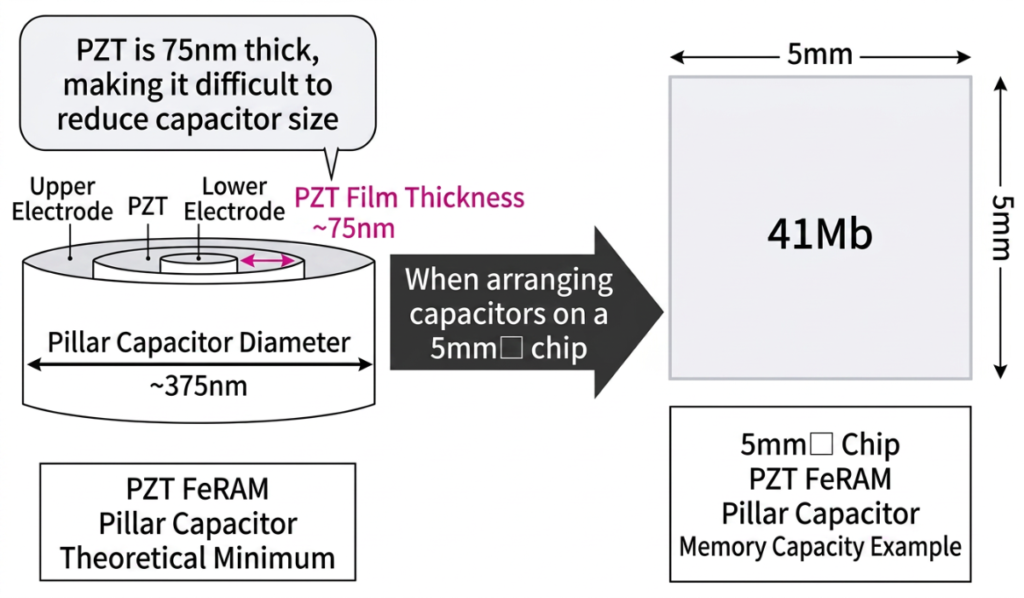
Because PZT is relatively thick at around 75 nm, reducing capacitor size is difficult. Even when arranging the theoretically smallest PZT FeRAM pillar capacitors with a diameter of 375 nm on a 5 mm-square chip, the resulting memory capacity is 41 Mb. (Figure 2)
*1: b: bit, a unit of memory capacity
*2: K (kilo, thousand): 1,000; M (mega, million): 1,000,000; G (giga, billion): 1,000,000,000
HZO: A Ferroelectric Material Similar to PZT
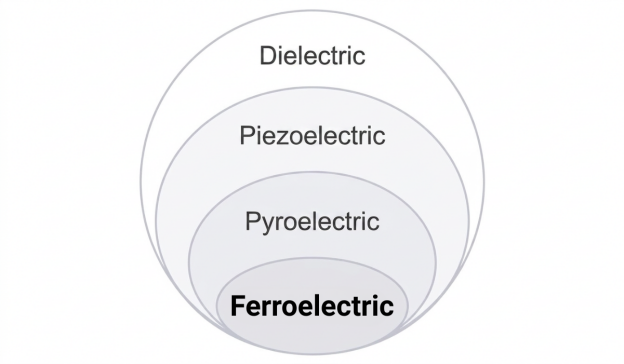
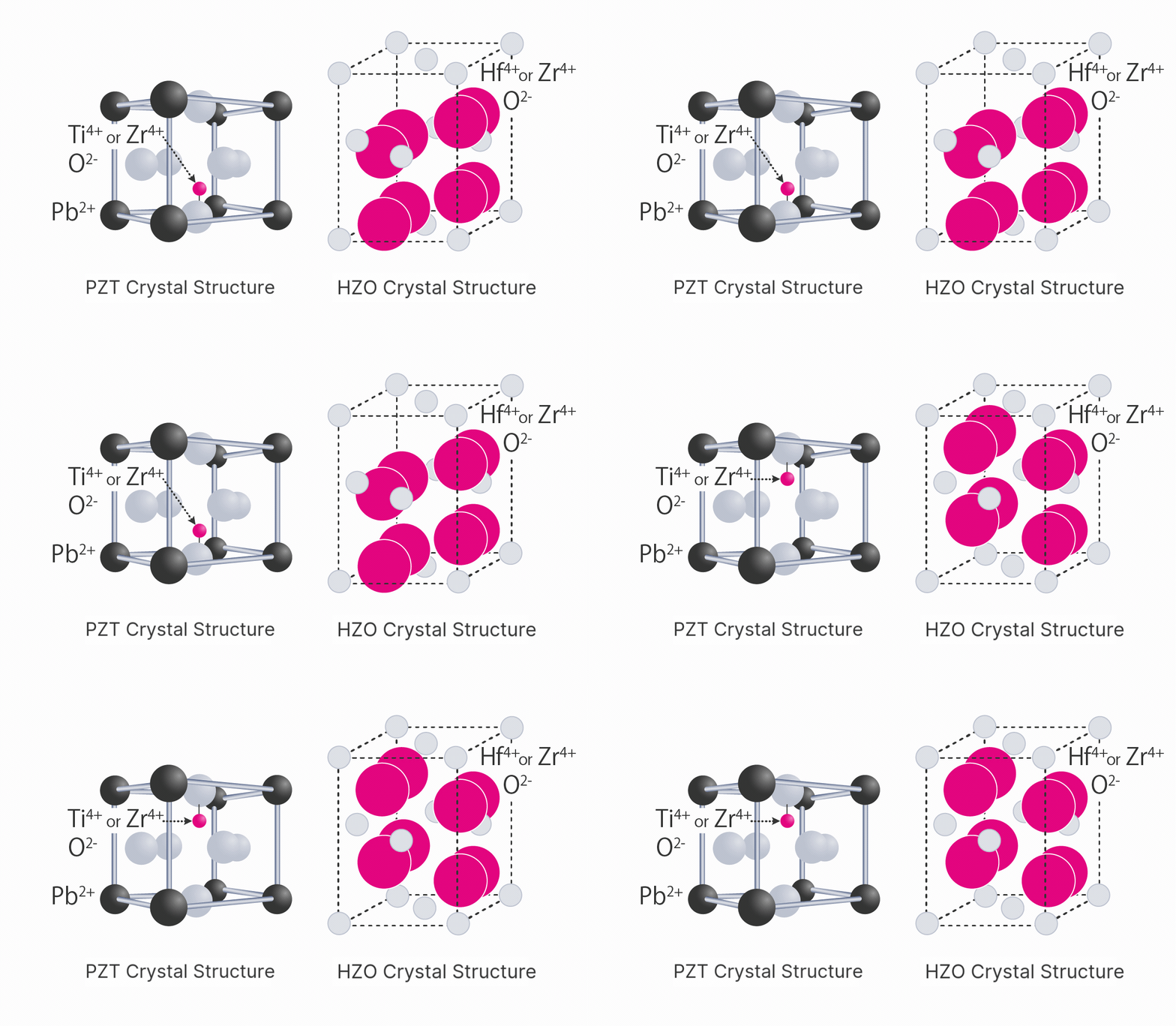
PZT is a ferroelectric material, and we have developed and mass-produced non-volatile memory using its polarization characteristics. HZO (Hafnium Zirconium Oxide) is also a ferroelectric material and can inherit the advantages of PZT FeRAM while overcoming its capacity-scaling limitations. In addition, the technologies and expertise we have accumulated through the development and mass production of PZT FeRAM can also be applied to HZO FeRAM.
HZO FeRAM Enables Higher Capacity
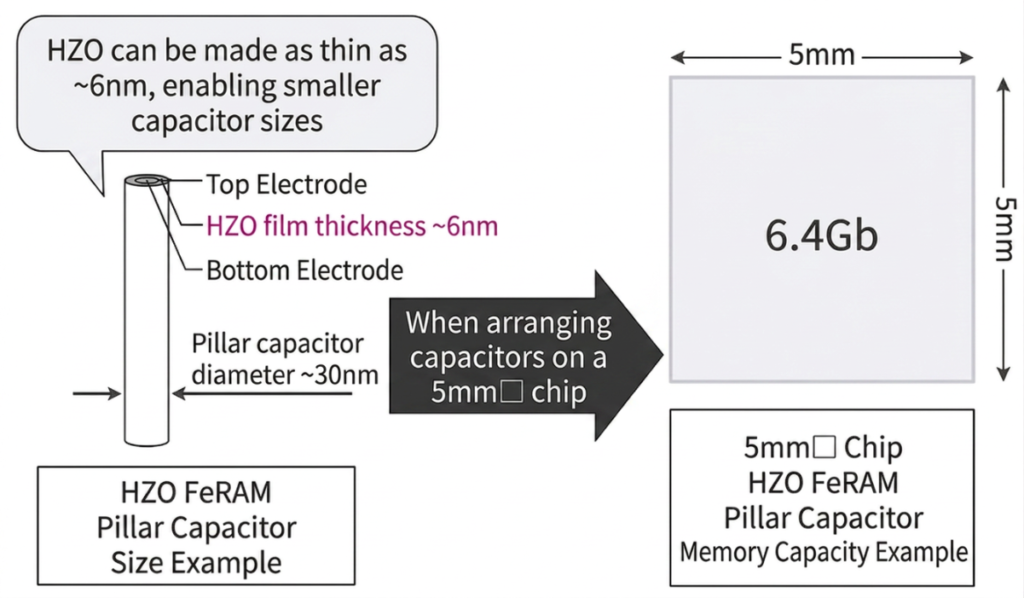
Because HZO can be made extremely thin, at around 6 nm, capacitor sizes can be significantly reduced. HZO FeRAM pillar capacitors can achieve diameters as small as 30 nm. When these capacitors are arranged on a 5 mm-square chip, the resulting memory capacity can reach 6.4 Gb. (Figure 4)
Collaborative Research Status of HZO Capacitors
To overcome the capacity-scaling challenge of PZT FeRAM, we are conducting research and development on HZO FeRAM.
The University of Tokyo Graduate School and our company jointly developed HZO capacitors featuring low-voltage operation and long endurance, and the results were published in the Technical Digest issued by the Symposia on VLSI Technology and Circuits.
- Successfully developed ferroelectric capacitors capable of achieving 100 trillion rewrite cycles at extremely low operating voltages below 1V.
- Established technologies that simultaneously achieve low-temperature fabrication, ultra-thin films, and high ferroelectric characteristics for HZO ferroelectrics, enabling ferroelectric capacitors compatible with BEOL (Back End of Line) integration, low-voltage data read/write operations, and high reliability.
- Contributed to further advances in computing technologies by improving the performance of non-volatile memory, an essential component for IT systems and AI computing. (Figure 5)

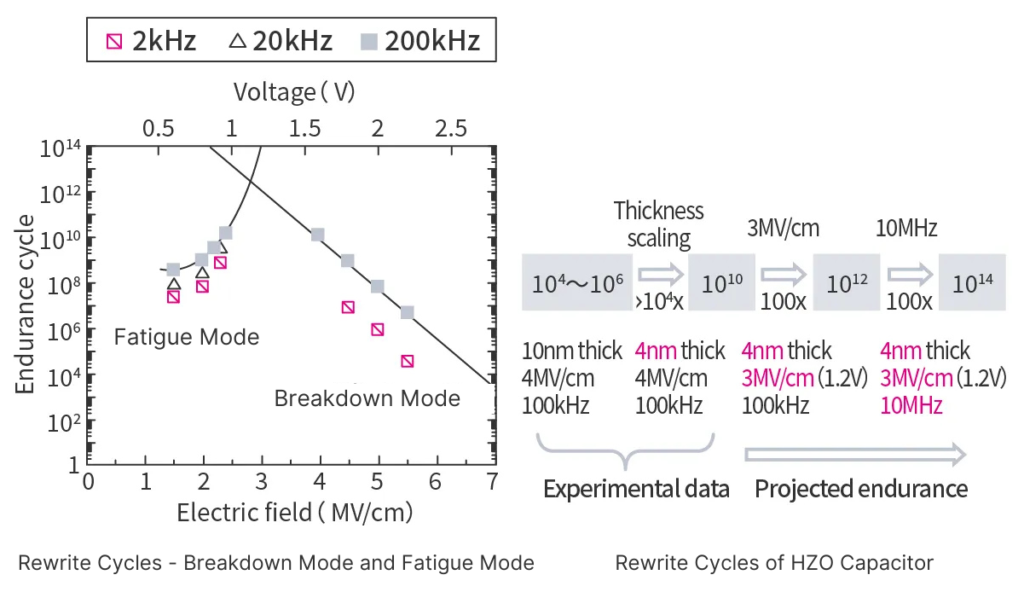
We also jointly reported HZO capacitors with improved endurance from the previous 10^12 rewrite cycles to 10^14 rewrite cycles through collaborative research between the University of Tokyo Graduate School and our company. (Figure 6)
Furthermore, the University of Tokyo Graduate School and our company jointly reported HZO capacitors with write voltages reduced to below 1V, compared to the previous high write voltage of 2.5V. (Figure 7)
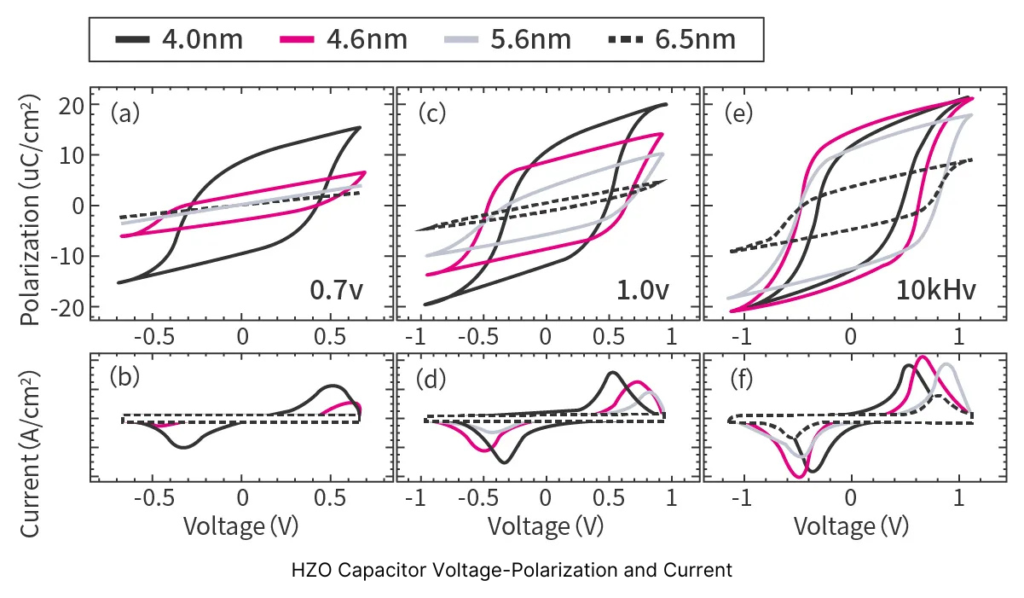
K. Tahara, K. Toprasertpong, Y. Hikosaka, K. Nakamura, H. Saito, M. Takenaka, and S. Takagi, Strategy Toward HZO-BEOL-FeRAM with Low-Voltage Operation (≤ 1.2 V), Low Process Temperature, and High Endurance by Thickness Scaling, 2021 Symposium on VLSI Technology
Beyond PZT FeRAM
PZT FeRAM is a superior memory technology with many advantages, but scaling to larger capacities remains a challenge. Looking beyond current PZT FeRAM technology, we are advancing research and development of HZO FeRAM, which can address this challenge of higher-capacity integration.