Manufacturing Innovation in FeRAM: Precise Control of Oxygen Addition in the Annealing Process
Is the annealing equipment leaking air? The beginning of high-performance FeRAM
FeRAM is a non-volatile memory technology widely used in electronic devices due to its high speed and low power consumption. Its performance has continued to improve over time. In this article, we examine the impact of oxygen addition during the annealing process on FeRAM performance.
What Is FeRAM?
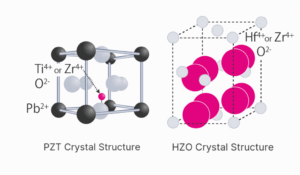
FeRAM(1) is a type of non-volatile memory that employs memory elements based on PZT(2) ferroelectric films, enabling high-speed and low-power data read/write operations. It is used in various electronic devices, including PCs, smartphones, and IoT devices.
(1) FeRAM: Ferroelectric Random Access Memory, ferroelectric memory
(2) PZT: lead zirconate titanate
Issues with Crystal Orientation of PZT Ferroelectric Films in Early Development
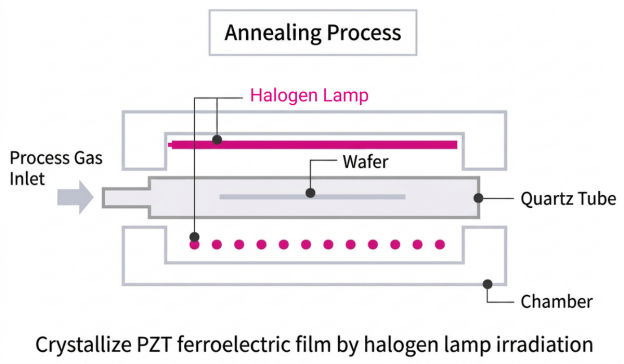
Annealing equipment plays a critical role in the FeRAM manufacturing process. It promotes the crystallization of PZT ferroelectric films through high-temperature heat treatment in an Ar atmosphere.
During early-stage development, we collaborated with a U.S. partner. Despite nominally identical Ar atmosphere conditions, significant differences in crystal orientation were observed between Japan and the United States, with the Japanese process exhibiting inferior orientation.
Collaborative Investigation Between Japan and the United States
Engineers in Japan and the United States jointly investigated the cause of this discrepancy. In Japan, it was found that introducing a large amount of O₂ into the Ar atmosphere degraded the crystal orientation, indicating that the O₂ partial pressure strongly influences PZT crystallization behavior. Independently, during the same period, an unintended air leak was identified in the annealing furnace in the United States, resulting in a small but unintentional introduction of oxygen. By correlating these findings, it was hypothesized that the addition of a small, controlled amount of oxygen could enhance FeRAM performance.
Realization of High-Performance FeRAM
To validate this hypothesis, systematic experiments were conducted in Japan in which the oxygen concentration during annealing was varied over a wide range. The results demonstrated that oxygen addition at an optimized low concentration enabled the formation of well-defined columnar PZT grains and significantly improved crystal orientation. Consequently, FeRAM performance was markedly enhanced. It was also found that an optimal oxygen concentration exists; both insufficient and excessive oxygen levels resulted in degraded crystal quality and device performance(3)(4).
By implementing a manufacturing process that precisely controls the oxygen concentration at a low level during annealing, high-performance FeRAM production was successfully achieved.
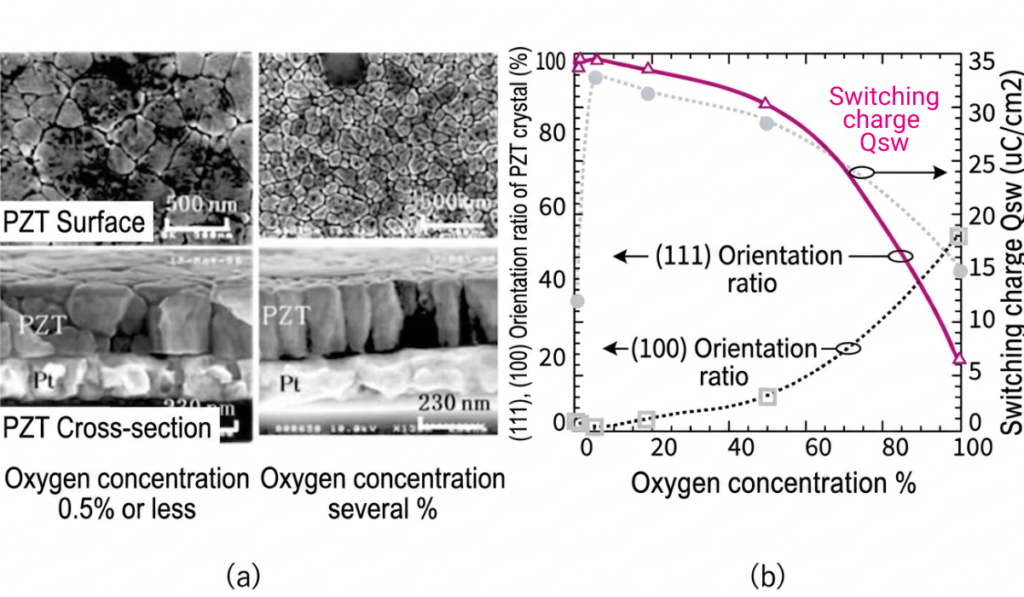
Figure: Dependence of PZT crystallinity and switching charge (Qsw) on oxygen concentration during crystallization annealing. (a) Scanning electron microscopy (SEM) images of the PZT surface and cross-sectional microstructure, and (b) oxygen concentration dependence of crystal orientation ratio and switching charge.
(3) Yukinobu Hikosaka and Takashi Eshita, “FRAM/CMOS Logic LSI Integration Technology”, Oyo Buturi (Applied Physics) 71(9), pp.1120–1125, 2001
(4) W. Wang, K. Nomura, H. Yamaguchi, K. Nakamura, T. Eshita, S. Ozawa, K. Takai, S. Mihara, Y. Hikosaka, and M. Hamada, “Control of La-doped Pb(Zr;Ti)O3 crystalline orientation and its influence on the properties of ferroelectric random access memory ”, Jpn. J. Appl. Phys Vol.56 10PF14, 2017
Summary
The development of high-performance FeRAM originated at the convergence of an unintended air leak in U.S. equipment and systematic investigation and analysis in Japan. This combination of unexpected findings and rigorous engineering led to a breakthrough in process optimization.