Optimizing Data Logging: Designing Bufferless Data Structures Using FRAM
This article summarizes the challenges of conventional memory in data logging and explains a design method for bufferless data structures that leverage the high-speed writing and high durability of FRAM (FeRAM, ferroelectric memory). It clearly explains specific implementation points that achieve power outage protection, RAM reduction, and improved recoverability.
Challenges of Traditional Memory in Data Logging Design
For high-frequency measurement logs, delays in the saving process and lifespan become design constraints. Flash memory has large erase units, making write cycle limits and wear leveling essential. As a result, RAM buffers and state management increase, and implementation and verification man-hours expand. Furthermore, unwritten data is easily lost during power outages, requiring double writing to ensure consistency.
Write Constraints and Endurance Issues in Flash/EEPROM
Flash and EEPROM cells have finite rewrite endurance, and directly appending logs leads to premature degradation. In addition, flash memory requires erasing before writing, resulting in erase-wait time and rounding of erase units, requiring page management even for small amounts of data. As a result, buffers for writing logs in batches, erase-area management, and wear leveling to equalize lifespan must be implemented, making the code and tests heavy. Especially when considering power outages, header duplication and checksum update order must be designed to maintain consistency during writing. As a result, CPU load and RAM usage increase, and low power consumption becomes difficult.
The Complexity of Memory Management Caused by Buffering Design
Traditionally, to absorb the difference between the recording cycle and the write unit, data is temporarily stored in RAM before being transferred to non-volatile memory. However, buffers involve increased branching depending on operational conditions, such as capacity estimation, how to discard data when it overflows, and the mixing of logs with different priorities. Furthermore, recording from multiple tasks requires mutual exclusion, which easily disrupts real-time performance. Designing to avoid writing within interrupts ultimately increases the number of queues and rings, leading to a bloated state. As a result, bugs are more likely to lurk, and time is spent analyzing hard-to-reproduce data loss or out-of-order records.
Power Outage Countermeasures and Log Loss Risk
Power outage is the most difficult aspect of log design. Not only unwritten data but also metadata corruption during writing can be fatal. For example, in a ring structure, if the information on the write position and valid range is corrupted, recovery is impossible, forcing a scan of the entire area. As a countermeasure, a combination of commit flags, generation numbers, dual headers, and CRC is used, but errors in the update order can actually increase the probability of corruption. Furthermore, establishing appropriate test conditions for power outage testing is difficult, and results fluctuate with temperature and voltage gradients. If the data structure, including recovery procedures, is not defined from the initial design stage, adding it later will only increase complexity.
FRAM Characteristics and Suitability for Data Logging
FRAM is non-volatile yet possesses the characteristic of high-speed byte-by-byte writing. Because it eliminates the need for an erase process, waiting times are predictable, and it is easier to plan for endurance even with frequent appending. As a result, the assumption of accumulating data before writing is weakened, reducing RAM buffers and complex scheduling. Even during a power outage, written data is immediately retained, simplifying commit design and minimizing log data loss.
FRAM Basic Operating Principle and Characteristics as Non-Volatile Memory
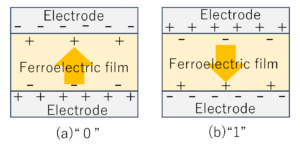
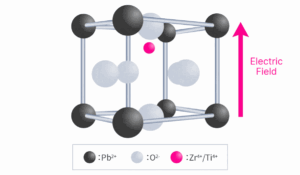
FRAM retains information in a ferroelectric polarization state, and data remains even when the power is turned off. It uses random access, allowing only the necessary locations to be rewritten by addressing them, making it suitable for updating log headers and appending small metadata. It is less constrained by erase block boundaries like flash memory, allowing for smaller write sizes. Furthermore, the constant write time and ease of estimating periodic control are design advantages. As a result, designs that place recording processing near interrupts and direct writing with short-period sampling become more realistic.
Impact of High-Speed Writing and High Durability on Design
High-speed writing not only reduces log delay but also changes the overall system structure. First, it allows a shift from the idea of absorbing peaks by increasing the buffer size to an idea of performing definitive writing with small granularity each time a sample arrives. Second, high durability simplifies write-distribution and reclaim processes to even out the lifespan, increasing the room for design without worrying about the frequency of metadata updates. This allows for safer, more frequent updates of ring log headers and generation numbers for fault recovery. As a result, robustness can be easily ensured with simple appending and clear commit points.
Contribution to Low Power Consumption and Real-Time Processing
In data logging, write power and startup time directly impact battery life. Because FRAM has no erase process, it is easier to suppress peak current and waiting time associated with writing, making it suitable for designs that return to sleep quickly. Furthermore, long wait times for write completion increase task switching, worsening both real-time performance and power consumption. However, with FRAM, wait times are predictable, leading to more stable designs. Additionally, the fact that written data remains even during power outages can potentially shorten the hold-up time required from supercapacitors, increasing the flexibility of power supply design. As a result, requirements can be more easily met with simple periodic processing.
Bufferless Data Structure Design Utilizing FRAM
Bufferless design is the concept of not leaving data in RAM for extended periods, but rather committing acquired data to non-volatile memory in small units. By utilizing the characteristics of FRAM, performance and lifespan issues are minimized even with reduced granularity of append data, allowing design focus to concentrate on consistency and recoverability. Specifically, a combination of append logs, lightweight headers, commit markers, and scan-based recovery creates a minimal data structure that is less susceptible to corruption during power outages.
What is Bufferless Design? – Concepts and Architecture
Here, “bufferless” doesn’t mean completely lacking RAM buffers, but rather not relying on a large staging area for storage. The basic configuration involves appending to FRAM immediately after acquisition, and performing subsequent processing with separate read tasks if necessary. Architecturally, a clear flow involves sequentially writing fixed-length records, adding a CRC for consistency checks to the end of each record, and finally updating the commit byte. This allows only records with an incomplete commit to be treated as invalid even if the power is lost midway through. The number of states can be minimized.
Sequential Log Structure and Pointer Management Methods
The key to implementation is how to manage pointers indicating the write position and information indicating the valid range of the log. The recommended approach is to create a small management area separate from the data area and use a dual approach where pointer records with generation numbers are written alternately. At startup, the management area is scanned to select the latest generation, and the data area is scanned from that position towards the beginning. Using a fixed-length data body allows for faster scanning; if using a variable-length data body, the length and CRC must be included. With FRAM, increasing the update frequency of the management area is less burdensome, making operation more resilient to power outages.
Design Points and Precautions for Implementation
The key points are atomicity and sequence. First, write the record body, then determine the header including CRC and length, and finally update the commit marker. Next, perform pointer updates after data writing to avoid situations where the pointer advances but there is no data. Furthermore, to prevent multiple writes to the same address, the management area should also be append-only and selected by generation number. Perform interruption tests during voltage drop to ensure that startup scanning can always be stopped.
Practical Guidelines for Bufferless Logging Design using FRAM
Design decisions are based on trade-offs between required recording cycle, acceptable data loss, power outage frequency, power consumption, and implementation effort. FRAM is effective in achieving both buffer reduction and recoverability, but it also has constraints such as capacity, unit cost, and interface speed. This chapter quantifies the effects of buffer reduction, identifies application areas, and organizes check items that should be addressed before implementation.
Effects of RAM Usage Reduction and Software Structure Simplification
The effects of bufferless logging are not limited to RAM reduction. By reducing the state machine, the causes of conflicts and data loss are reduced, lowering the burden of review and verification. For example, the conventional multi-stage configuration can be reduced to a three-stage configuration: acquire, append, and commit. This shortens the interrupt-disabled interval and reduces timestamp drift and jitter. On the other hand, it is necessary to estimate whether the scan recovery time meets the startup requirements and, if necessary, implement measures such as taking periodic snapshots.
Applicability Criteria for Industrial Equipment and IoT Devices
In determining applicability, first organize the data based on the write frequency and the risk of power outages. The more frequently logs are recorded and the more likely power outages are to occur on-site, the greater the value of an append-type system that allows for immediate confirmation. Furthermore, log consistency is crucial for IoT devices where communication is unstable and local storage is essential. For applications requiring long-term storage of large capacities at low cost, a two-tier configuration with another medium is realistic. A configuration that uses FRAM as the primary log and transfers data to another medium in batches is effective.
Design Checkpoints for Achieving High-Reliability Logging
There are three points to consider before starting. First, the recovery procedure must be specified. Second, the write order and redundancy policy must be fixed. Third, the test conditions must be designed, combining voltage gradient, temperature, bus speed, and interrupt load during power outages to confirm that the system does not fail even under worst-case conditions. In addition, the overwrite policy for a full log and the restart point after an abnormal reset must be determined. If these conditions are met, the advantages of FRAM can be safely realized.
RAMXEED FeRAM Product Lineup