What Is Non-Volatile Memory? Types, Features, and Applications
Author Information
Takashi Eshita Ph. D.,
Senior Expert, RAMXEED Ltd.
Non-volatile memory is a type of storage memory used in computers, smartphones, and other electronic devices. Its defining feature is the ability to retain stored data even when external power is removed. This article explains the different types of non-volatile memory, their characteristics, and their applications.
What Is Non-Volatile Memory?
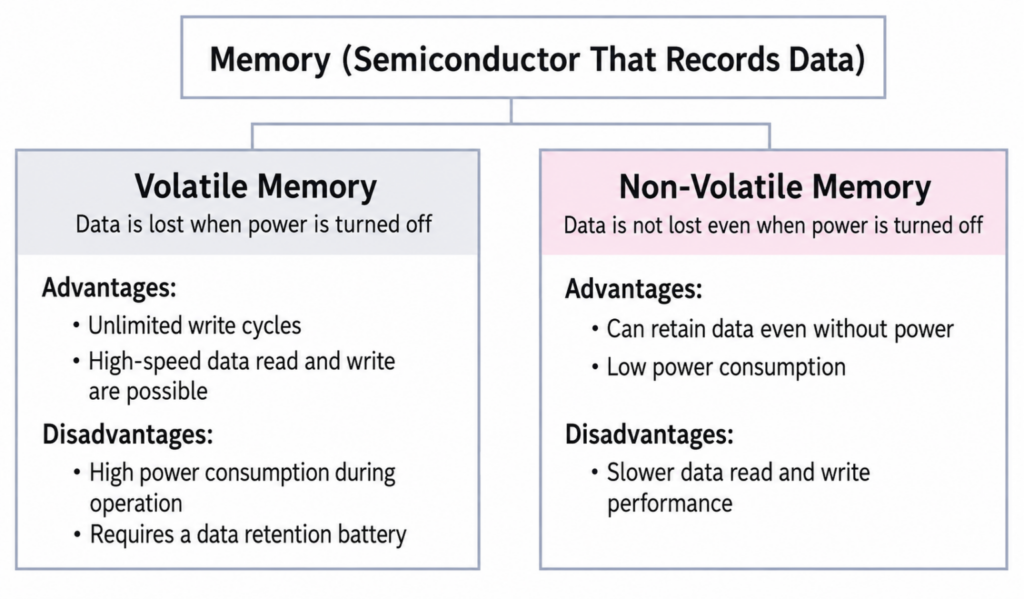
Non-volatile memory is a type of storage memory used in computers, smartphones, and other electronic devices that can retain stored information even without an external power supply.
In modern computers, data that must be processed directly and at high speed by the CPU (Central Processing Unit) is generally stored in volatile memory, which cannot retain data without power. Data that is accessed less frequently is typically stored in non-volatile memory.
There are many types of non-volatile memory, including semiconductor memory, magnetic tape, and optical discs. This article focuses specifically on semiconductor-based non-volatile memory.
Types and Features of Non-Volatile Memory
Non-volatile memory can be broadly divided into two categories: read-only memory (ROM) and rewritable non-volatile memory. In the former, data is written during the manufacturing process, while in the latter, users can rewrite data as needed.
ROM includes mask ROM, in which information is written during manufacturing, and OTP ROM (One-Time Programmable ROM), which allows the user to write data only once. Among rewritable non-volatile memories, EEPROM (Erasable Programmable Read Only Memory) and flash memory, commercialized in the 1970s and 1980s respectively, have been widely used.
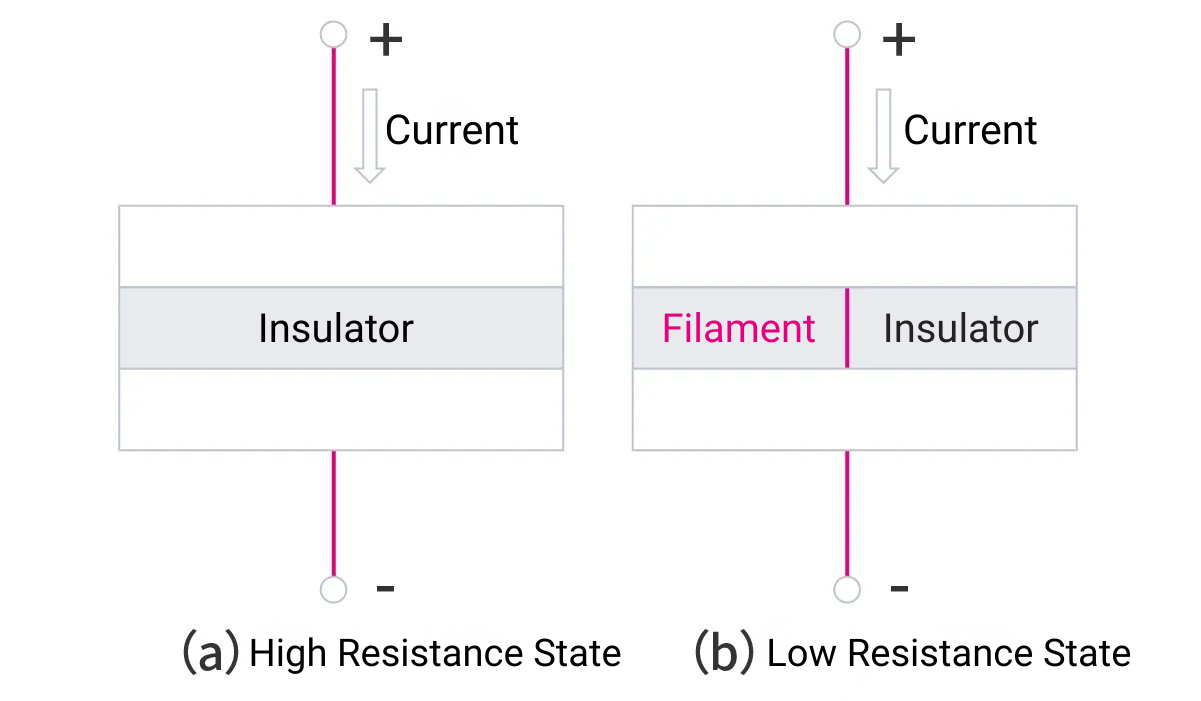
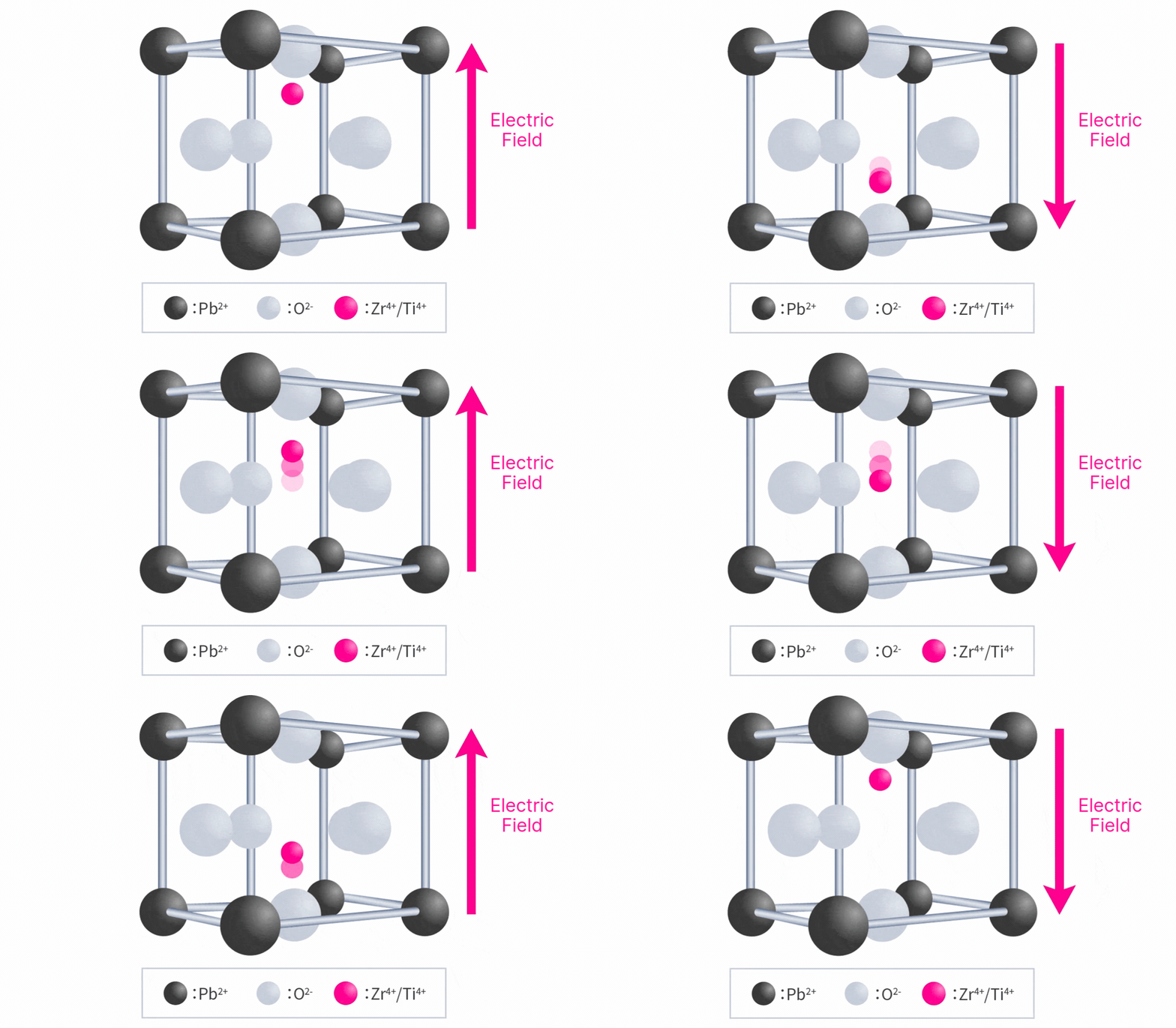
Since the 2000s, emerging memories capable of high-speed rewriting have attracted attention, including ferroelectric memory, magnetoresistive memory, resistive memory, and phase-change memory[1]. RAM (Random Access Memory) implementations of these technologies, which allow random read and write operations, are known as FeRAM (Ferroelectric RAM), MRAM (Magnetoresistive RAM), ReRAM (Resistive RAM), and PCRAM or PRAM (Phase Change RAM).
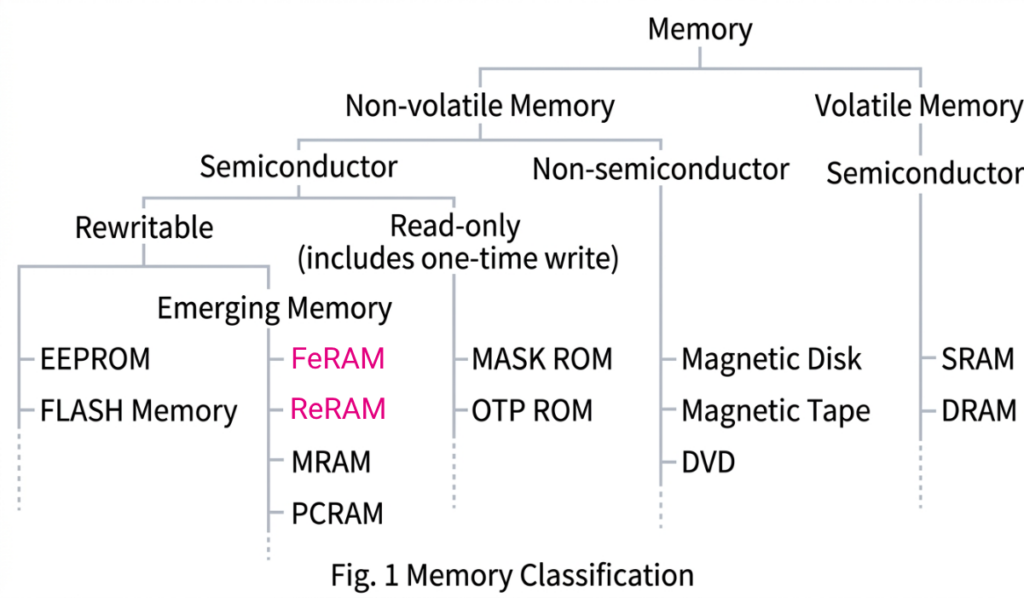
The operating principles and qualitative characteristics of each memory type are summarized below.
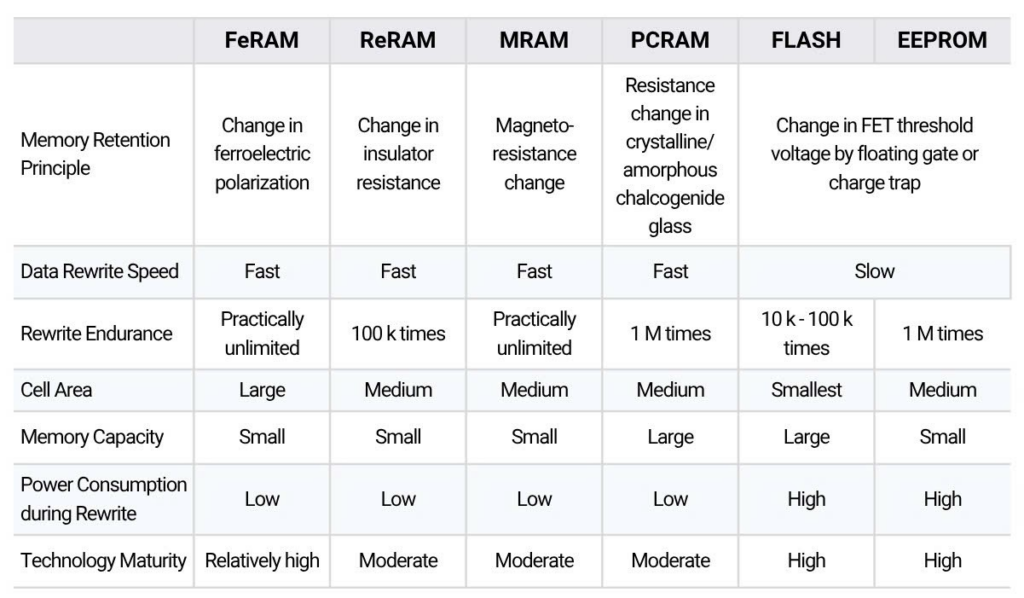
Table 1. Comparison of memory retention principles and characteristics of Non-volatile memory
The FeRAM manufactured by our company has a smaller storage capacity than flash memory, but offers faster rewrite speeds, extremely high rewrite endurance (more than 100,000 times higher than flash memory [2]), and low power consumption during rewriting. Having been in production for 25 years, FeRAM is considered more mature and highly reliable compared with other emerging memory technologies.
The ReRAM products handled by our company are characterized by optimized rewrite algorithms that achieve one million rewrite cycles, equivalent to EEPROM and higher than flash memory. To prioritize the low peak operating current and low power consumption required for battery-powered devices such as hearing aids, the rewrite speed itself is slower than that of typical ReRAM devices.
Applications of Non-Volatile Memory
Flash memory has relatively slow rewrite speeds but offers extremely large storage capacity, making it suitable for use as storage memory in computers. Emerging memories feature low power consumption, high-speed operation, and near-unlimited rewrite capability, making them suitable for industrial data logging, smart meters, RFID (Radio Frequency Identification), and similar applications.
Applications of Non-Volatile Memory in Artificial Intelligence (AI)
With the recent spread of generative AI, the power consumption of computers processing massive amounts of data for machine learning has increased rapidly. One contributing factor is the use of volatile memory inside computers, particularly for storing “weights” used during machine learning.
Machine learning is performed using artificial neurons and neural networks known as perceptrons, which consist of multiple layers [3]. Each layer (node) performs multiply-accumulate operations, and the results are passed to the next layer with assigned “weights.” Using non-volatile memory for these weights is expected to reduce power consumption.
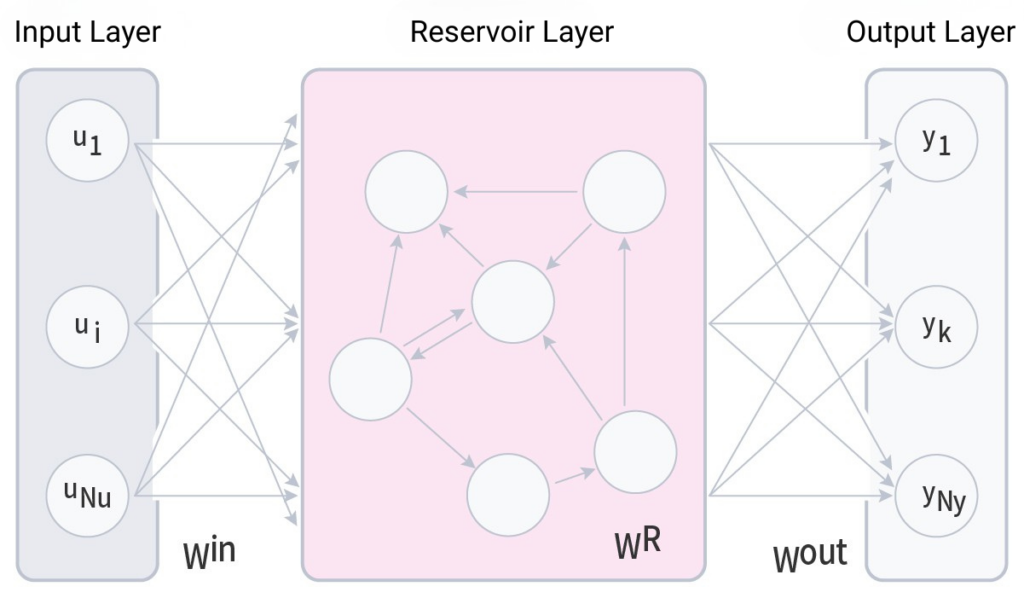
Figure 5. Principle of Echo State Networks. Data in each layer is propagated using weights win, wR, and wout. In reservoir computing, nonlinear physical phenomena are utilized in the reservoir layer, and only the output weight wout is adjusted.
Research on machine learning using FeRAM is actively progressing, particularly in a method known as reservoir computing, which is one approach within echo state networks (Figure 5). By adjusting weights only at the final output node and utilizing nonlinear physical phenomena in the intermediate reservoir layer, low-power machine learning can be achieved [4].
A research group led by Professor Shinichi Takagi at the Graduate School of Engineering, The University of Tokyo, which is conducting joint research with our company on ferroelectric crystals used in FeRAM, has presented reservoir computing that utilizes the nonlinear relationship between ferroelectric polarization and electric fields, attracting significant attention worldwide [5].
References
[1] G. Molas et al., Appl. Sci. vol. 11, p.11254 (2021),
B. Li et al., p.381, GLSVLSI 2019, and data from our company and memory manufacturers (Everspin, Infineon, Samsung, Kioxia).
[2] Fujitsu Semiconductor Memory Solution, Overview and Track Record of FeRAM (White Paper).
[3] W. Gardner et al., Atmospheric Environment Vol. 32, p.2627 (1998),
M. Popescu et al., WSEAS Transactions on Circuits and Systems, Vol. 8, p.579 (2009).
[4] Kohei Tanaka et al., Reservoir Computing, Morikita Publishing, 2021,
K. Kamimura et al., ESSDERC 2019,
S. Oh et al., APL Materials 7, 091109 (2019),
M. Lederer et al., IEEE Transactions on Electron Devices 68, p.2295 (2021).
[5] E. Nako et al., 2020 Symp. VLSI T,
S. Takagi et al., IPRS 2024.